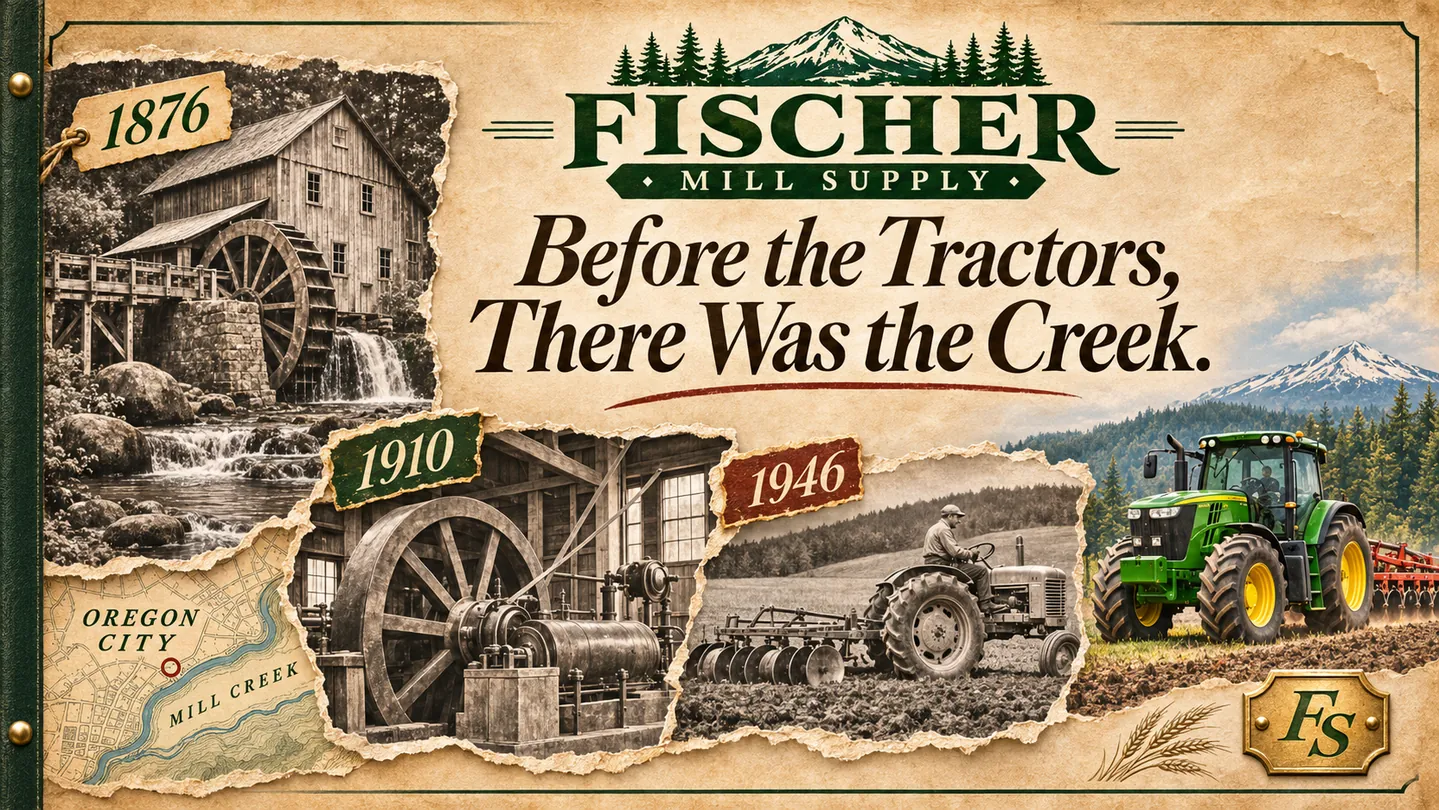
The oldest clue is not a tractor. It is a creek. Long before anyone was shopping for horsepower on Fischer Mill Road, water itself was driving the machinery.
The advertisement that started another story
In a 1975 farm-equipment newspaper page, the ordinary machinery of regional life is on display: implements, livestock, used tractors, pickups, and whatever somebody needed to sell before the next season. Tucked among them is a notice for Fischer's Mill Store & Supply, advertising feed and seed beside David Brown tractors, Case machinery and Bolens compact tractors. It supplies a telephone number and the Fischer Mill Road address.
The small ad is a surviving trace of a practical store doing its daily work. Behind that familiar address was a family business whose published history reaches back to the 1880s.
It raises a question worth following through a century of machinery: what did this business actually sell before the first tractor sat on the lot?
A mill before the name on the dealership
The answer reaches back to Clear Creek, the local waterway that gave a gristmill the power to do useful work. Fischer Mill Supply traces its start to 1889 and describes its predecessor as a water-powered mill and general store. That is a very different definition of equipment supply: not a showroom full of powered machines but machinery that helped neighbors process what they grew.
The creek was here before the family name
A clue in Oregon's historic-site records takes the story further back than the date most people associate with the dealership. A mill stood along Clear Creek in the 1860s, before August Fischer purchased it in 1889. It passed through other ownership first. That matters because the name Fischer's Mill did not begin with an untouched frontier enterprise. The family entered a working place that had already become important to a farming area.
The district itself was changing. Roads, local communities, postal routes and farms were being established around the creek and the surrounding countryside. A mill here meant that grain could be processed closer to the people growing it. There was no need for every farm to maintain its own milling equipment. Families could bring part of the harvest into a place built for the task, exchange news and supplies, and return to their work. The records do not preserve every conversation at that mill, but they do show why such a place belonged in the landscape.
The more interesting question is what the family inherited when it took over. Not simply a building or a waterwheel, but a relationship with people whose work depended on it. Later generations would sell tractors instead of providing only milling services. The useful continuity was not the machine itself. It was that the business was located where its neighbors could bring practical problems and find somebody who understood them. See Oregon's historic account of the mill.
An Oregon state historic-site narrative traces the mill to the 1860s, when Alwin Harding built it on Clear Creek. It records Mathias Carl Kirchem acquiring the mill in 1867 and a Fischer purchase in 1889. The source notes below explain a difference in the recorded first name.
A mill does not need a dramatic founding speech to matter. A community with grain to process needs somewhere to take it. The mill was a piece of working infrastructure long before it became the historical beginning of a dealer story.
1889: the family story begins
Fischer Mill Supply’s family history credits Gustav Fischer with establishing the business in 1889. The Redland-Viola-Fischers Mill community account remembers Gustav Franz Fischer operating the mill and store with his family.
The setting explains the business as much as the date does: a creek, a working mill, a store and neighbors who depended on what those places could do. That family connection would continue as the machinery changed.
Water, gas, diesel: three eras of useful power
The local community history preserves another detail: the gristmill's power source changed. It was originally powered by Clear Creek, then converted to gas and later to diesel. The dates of those conversions have faded from the record, but the succession of power systems tells a story of its own.
The need stayed recognizable while the means of meeting it changed. The same basic pattern appears later when the family began selling tractors: a new form of power did not abolish agricultural work, but it changed what a customer could ask a machine to accomplish.
A family photograph or equipment record from those conversion years would add another chapter to the mill’s working history.
1929 and the next pair behind the counter
The community group's account dates Gilbert Fischer's marriage to Lillian Scheef to 1929 and says they began operating the business at what it calls the present location. This helps connect the older mill history to a more recognizably modern family enterprise.
What did the counter look like? The old records don't say from these public summaries. We can say that the business was rooted in a rural community where a store and workshop could have been essential gathering places. What an ordinary day at the mill felt like is the part still missing.
An old photograph or a family memory could bring that scene to life. A photograph with names, a ledger or a remembered repair could turn an outline of dates into a story that feels like someone was there.
1945: the product changes and the work continues
The dealership dates its first Case tractor line to 1945. The business that had once been linked to processing grain was now supplying machines that helped people do work in the field. The company's account also describes the addition of new and used farm equipment.
A different kind of power arrives
When the family began selling tractors in 1945, the leap from milling grain to supplying farm machinery was larger than a simple change of product. A waterwheel was tied to a particular creek and a particular building. A tractor could take mechanical power from one part of the farm to another. It could pull an implement across fields, haul a load, or drive equipment that previously required animals or stationary engines. For the family business, the center of gravity was moving from processing a crop to equipping the person who produced it.
The Redland-Viola-Fischers Mill community history describes several generations making that transition. Gilbert and Lillian Fischer began operating the business in its present location in 1929. The gristmill shifted from water to gasoline and then to diesel power. Their son Gene and daughter Arlene later managed the enterprise, and Gene's son Dean carried it forward with implements, parts and hardware. The public record supplies the names and changes, though not a tidy account of every difficult year or business decision.
There is a quiet lesson in that sequence. A family can remain in one place for a very long time without doing the same work forever. The creek supplied power until other technologies became more practical. The store added equipment as farmers adopted it. Spare parts became as important as the original sale. Each transition required learning a new set of machines and the problems that came with them. It takes more than nostalgia to keep a business useful across generations. Read the community's family chronology.
A local community history describes the transitions with unusual clarity. Gilbert and Lillian Fischer began operating the business in its present location in 1929. The gristmill passed through water, gasoline and diesel power; in 1945, the family began selling tractors. That was more than a change in inventory. Instead of only preparing the harvest or helping a farmer obtain supplies, the business could now supply the power to plant, cultivate and haul it.
Generations later, Dean Fischer carried the family enterprise forward with implements, parts and hardware alongside its equipment business. A long life like this is easy to reduce to an anniversary number. The more revealing evidence is the succession of different machines that people needed to keep the same farms operating. A useful dealership does not survive by preserving yesterday's catalog. It survives by learning the next season's work.
That distinction matters. Equipment buyers do not all need a new machine. A used tractor, properly matched to a farm's needs and budget, can be the more useful tool. The dealership's later advertisements repeatedly put new and used equipment alongside sales and service. A customer needed more than a purchase price; they needed a machine that could keep working.
Across those advertisements, sales and service appear together: help finding a machine, then help keeping it useful.
The newspaper trail from 1965 to 1975
A 1965 Sandy Post page places Fischer Mill Supply in the farm-machinery classifieds with a compact Case-machinery listing. It gives an Oregon City mailing address and telephone number. There is no extravagant storytelling, just the straightforward language of a working store.
One classified ad, two kinds of customer
In April 1971, a Sandy Post farm-equipment page carried an advertisement for Fischer Mill Supply listing Case machinery and new-and-used sales and service. Nearby classified listings offered plows, lawn tractors, a hay baler and other agricultural equipment. By May 1975 another advertisement for Fischer's Mill Store & Supply placed feed and seed beside David Brown tractors, Case farm machinery and Bolens compact tractors. The typography was modest. The combination of goods was not.
Those two advertisements tell us what a customer could reasonably expect from the store in that period. A farm family might need seed for the next planting, a small implement for everyday work or help with a machine that was no longer running properly. Large manufacturers supplied much of the equipment, but a local counter connected it to the people who had to keep farms operating. The same printed address and telephone number appeared among advertisements for all sorts of practical rural needs.
The ads also capture a period before online inventories made equipment prices seem universally visible. Finding the right machine could depend on local advertising and a personal visit. A dealership's knowledge of what had been traded in, repaired, or used by another customer was valuable. That is why an old classified page is not merely a piece of nostalgia for an editor. It is evidence of how equipment buying actually happened.
The machines on the page may be long gone. What remains recognizable is the customer who needs something specific and cannot wait forever to get back to work. Open the 1971 equipment listings.
In April 1967, another newspaper listing places the business among local sellers of farm and utility equipment. In 1975, the advertisement grows more specific: feed, seed, David Brown tractors, Case machinery and Bolens compact tractors. It also gives the Fischer Mill Road street address rather than relying only on the older rural route reference.
The same name recurring in different years matters more than any one ad. It shows a business continuously participating in the local marketplace while the mix of products and the ways people found a dealer changed.
The original newspaper pages are linked in the sources below, preserving these small pieces of the store’s everyday history.
1993, 2017, and another change in the yard
The family account says Gene and Arlene Fischer ran the business through the later decades of the Case era. In 1993, Gene and his son Dean joined with AGCO to carry Massey Ferguson equipment. The company remembers it celebrated 30 years of that relationship in 2023.
In 2017, Fischer Mill Supply added Kioti tractors, attachments and mowers. Its published history also records a 2024 five-star dealership distinction from AGCO, another milestone in the family’s long equipment business.
Changing product lines means much more than moving signs. Machines require parts systems, technician knowledge, training, different attachments and new explanations at the sales counter. Over several generations the dealership has repeatedly had to learn new iron while retaining old relationships.
A working farm behind the dealership name
Today the company's public site identifies Dean Fischer as president; Sheryl Fischer in bookkeeping; Chelsea Randall in marketing and office management; Brady Fischer in service; and Tanner Fischer in parts and hardware. The family also describes its own agricultural work: hay, wheat, oats, cattle, pumpkins and Christmas trees.
This is the detail that gives the modern dealership more character than a row of brands. The people offering machinery also say they live with some of the work machinery exists to perform.
The dealership website contains older photographs of buildings, people and tractors. If the family chooses to contribute approved images and firsthand memories, these chapters could become a true oral-history and photograph feature instead of a carefully sourced public-record edition.
The work carried forward
A creek powered the first machinery. Later generations learned new engines, new tractors and new product lines. The surviving record follows that work through the family, the farm and the parts counter.
There will be more stories in family albums and the memories of mechanics and customers. Those contributions are welcome here. For now, the old records give a local business its proper place in a much longer history of people getting useful work done.