Most equipment-dealer profiles begin with a showroom, a list of brands, and a sentence about customer service. This one begins with a house.
The man who counted every nail.
In a City of Gresham historic-landmark file, between property descriptions and old photographs, there is something unexpectedly personal: a record of a family paying close attention to what it took to build a home.
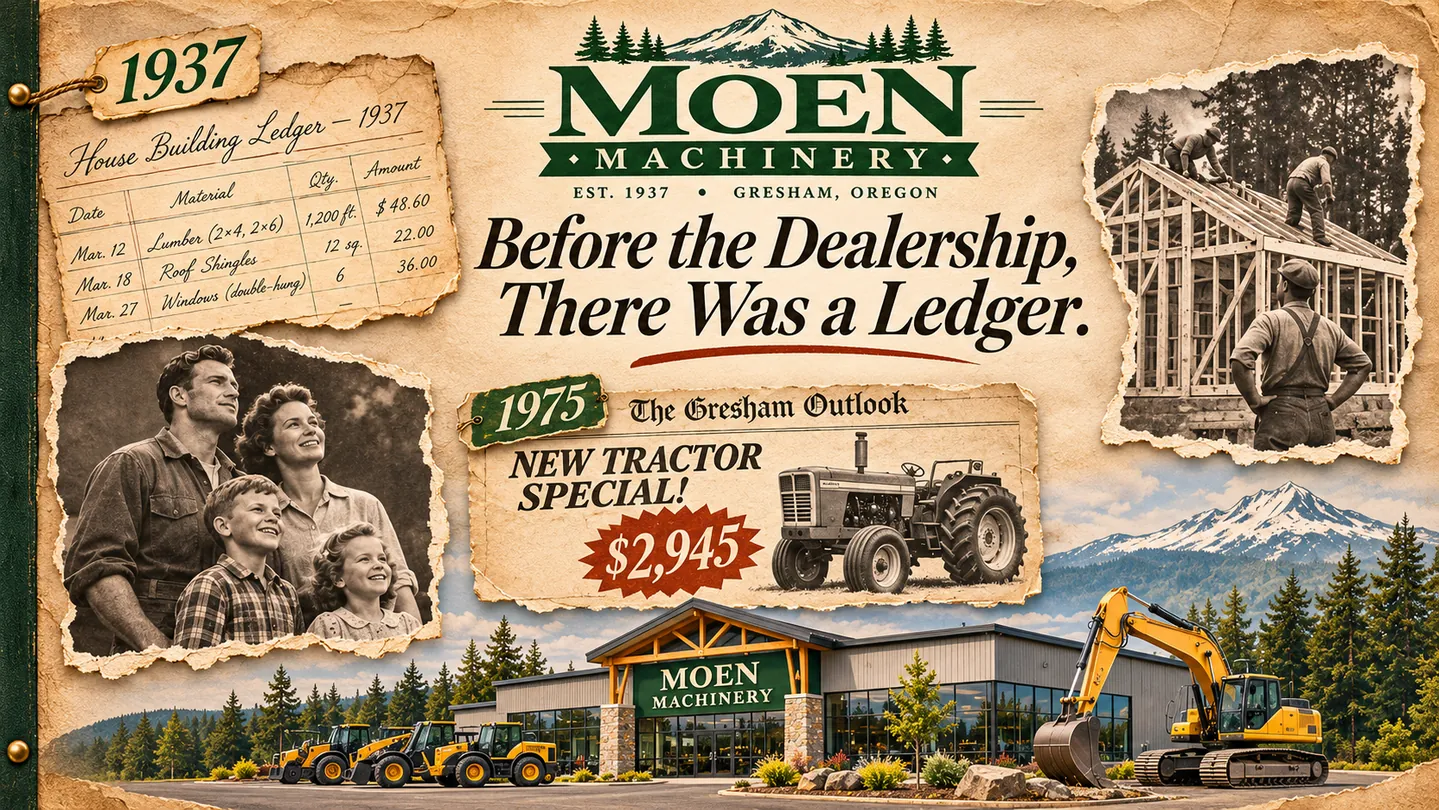
In 1937, George and Hazel Moen built a house as the Depression loosened its grip on the region. The city’s research says they kept a ledger so detailed it accounted for nails, boards and bricks. One photographed page survives in the city's inventory. The documented cost estimate was $1,956.
It is easy to see an old house ledger as a curiosity. But that document reveals a habit: knowing the cost of what you build, being careful with resources, and taking the time to put things down correctly. The city’s historian explicitly connects that frugality with George Moen’s later achievements in business and public service.
Ten years later, the Moen name would be on a machinery company. The little ledger gives this family history a fitting place to begin: with the care it took to build something that would last.
The City of Gresham’s 2016 inventory documents the George Moen House, includes a ledger-page photograph, and explains the family’s record keeping. Open the archival file; search within the PDF for “George Moen House.”
He was helping build Gresham before he owned the machinery company.
George Moen's story was already entwined with this place. Born in Alberta, raised in Washington, he came to Gresham in the late 1920s. He worked at Hessel Motor Co. before becoming a partner in Moen & Barr Machinery in 1947. After becoming sole owner, he renamed it Moen Machinery.
The records of George Moen's life tell two stories that deserve to be read together. One concerns machinery. The other concerns a town. Gresham's historic inventory preserves his years on the City Council, his service as a volunteer firefighter, and his involvement in the Masonic lodge, civic organizations and a local singing group. These details do not prove that every machine sold by Moen Machinery changed a life. They do show a founder whose name appeared in public life well beyond the business sign.
A local business is part of a community in quieter ways than a grand opening: it hires people who live nearby, repairs the things they use to work, and helps a town retain practical knowledge. The obituary recorded in the city inventory makes Moen's contribution tangible. George helped build both a dealership and the network of neighbors around it. That is why the story of an old ledger matters. Someone who kept track of nails and construction expenses also took the time to show up for the community where the house stood.
But the machinery business was only one side of his contribution. Gresham elected him to city council in 1945. The city’s historic research credits his council tenure with work on paved streets, sidewalks, Johnson Creek flood control, building standards and land for a new city hall. In the 1940s, he also served as Gresham’s volunteer fire chief and helped extend fire protection beyond the city limits.
Think about what that means to the next person who drives to Hogan Road to buy a tractor. The business did not simply arrive in a growing city and sell the machines people needed. Its founder was helping improve the very infrastructure of that city.
There is a quiet kind of achievement in that. It rarely fits on a dealership banner. It matters just the same.
The George Moen House is identified as Gresham Historic Landmark No. 25. The city's assessment describes George's business and civic influence as part of why the house matters. Read the city's assessment.
Then came the harder job: changing without losing the place that made you.
Howard Moen was born in Gresham in 1929, graduated from Gresham Union High School in 1947, studied business at Lewis & Clark College, and served in the Army’s 82nd Airborne. He had started helping at the family machinery business while in college. Eventually, he took the reins.
George retired in 1968. The next chapter was not just about keeping a surname on a sign. According to the family’s published account of Howard’s life, he and his wife Colleen helped move Moen Machinery from its original Powell Boulevard location to Hogan Road. The obituary credits Howard with adding the Kubota tractor line early in the brand’s American history and later bringing in Stihl and Honda.
Those are easy changes to summarize after the fact: a move, a new manufacturer, new product lines. For the people making them, each represented a bet on what local customers would need next. A dealer that began serving farms had to recognize a changing landscape. Nurseries, landscapers, contractors, local governments and homeowners were asking for different machines and different kinds of help.
Years later, Greg Moen described how the business had shifted from farm supply through logging tools and back toward a broader equipment market. In a 2007 trade interview, he connected that diversification to Gresham’s transition from traditional agriculture toward nurseries and development.
Continuity, in this family, did not mean standing still. It meant staying close enough to the people around them to know when the work had changed.
George and Hazel.
Howard and Colleen.
Greg and Cindy.
Three generations appear across Gresham’s historic record, the family’s published remembrance of Howard, and a 2007 industry interview. What ties them together is not a single unchanging product. It is the local business that survived the changes.
Forty-nine years ago, they put a promise in the local paper.
The most revealing discoveries in a family-business history are not always the grand openings. Sometimes they are tucked into a few inches of newsprint, surrounded by farm classifieds, used trucks and the weekly events of a town that hadn't yet become the city people know now.
There is another small newspaper scene worth keeping. In January 1965, the Sandy Post announced the first anniversary of Moen Machinery's Sandy store. Howard Moen and his father George operated the two locations. To celebrate, the dealership planned chainsaw demonstrations, invited visitors to try newer models and offered a McCulloch saw as a giveaway. The report is specific enough to picture the kind of business they were running: a father and son, machines that customers could actually handle, and an invitation to come see for themselves.
That invitation makes an interesting companion to the 1977 service advertisement elsewhere in this archive. The product line could change and the lot could fill up, but the selling argument was not merely that a machine existed. The customer had to be able to see it work, ask questions, and know someone would maintain it afterward. Long before online product comparisons, trust was built in the hours spent showing what a tool could do.
On September 4, 1975, an advertisement in the Gresham Outlook offered a Kubota B6000 tractor for $2,945. Its printed features were practical: a 12.5-horsepower diesel engine, four-wheel drive and an eight-gear transmission. Beneath the machine sat a name and address: Moen Machinery, 268 NE Hogan, Gresham.
The old price places the family at a vivid moment in the business’s evolution: after Howard and Colleen had helped move the operation and while the company was introducing compact tractors to a changing region. It was another wager on what people would need next.
The ad specifies a 12.5-horsepower diesel, four-wheel drive and eight gears. It gives the Hogan Road address already familiar to Gresham today.
See the original newspaper pageThe advertisement emphasized matching people to the right mower or tiller, then reminded readers that the dealership serviced what it sold.
See the original newspaper pageThese are original editorial summaries of publicly archived newspaper advertisements, not reproductions of their layout or imagery. The pricing and historical statements describe 1975 and 1977, not current offers.
Two years after the tractor ad, a March 24, 1977 ad in the Sandy Post celebrated Moen Machinery's thirtieth year. It wasn't just a sale announcement. It argued that people should choose equipment suited to the job and emphasized after-sale service.
Read that alongside the 2007 interview. Three decades later, the dealership was still describing shop scheduling, commercial-customer turnaround, specialist technicians and occasional loaners. Two published snapshots, thirty years apart, show the same priorities: the machine matters, and what happens after the sale matters too.
That's the kind of continuity you cannot buy with a modern website template. It has to happen in the shop, over years, with real customers and mechanics whose names might never reach the company's history page.
By 2007, they had a different problem. Too much business for the lot.
Some of the most revealing evidence about a business is found in the unglamorous parts of a trade magazine interview. In April 2007, Green Industry Pros visited the dealership and found a family operation wrestling with a very physical problem: where to put the equipment.
The yard was so full that machines sometimes had to be stored across the street on a neighboring RV dealer’s property. Greg Moen and his sister Cindy Luebbers, then identified as co-owners, had considered a move. A larger property could ease the crowding, but the existing location kept them accessible to the homeowners, nurseries, contractors and maintenance crews who depended on them. The very location creating the headache was part of the reason the business worked.
There is a surprisingly human detail in that picture. To keep selling iron, the dealership needed the cooperation of another business across the street. It's a small local arrangement, but the kind that makes sense to anyone who's had to keep a shop going while the day's problems pile up.
The 2007 article recorded 18 full-time and three part-time employees, and a customer mix of roughly 40 percent commercial to 60 percent consumer. Behind those numbers was a balancing act: the nursery manager whose loader needed to move stock, the contractor with an idle excavator, and the neighbor whose mower had failed on a Saturday. Different customers, with the same need for someone behind the counter who understood the work.
“We have to know what we’re selling, and also what our competition is selling.”
A professional customer may have spent the previous night studying competing machines. Dirksen knew a sales rep could not bluff their way through that conversation. The line stands out because it describes preparation as respect: learn the machine, learn what else is available, and earn the right to recommend one.
The 2007 reporting described salespeople visiting commercial customers, demonstrations of compact excavators, specialist service technicians, priority turnaround for landscapers and loaner equipment in certain situations. It is a portrait of the people working to keep customers earning after the sale.
The family name is on the building. The work belongs to more people.
A surname opens a story. A service department, sales floor, loading crew and parts counter are how it keeps going.
Family businesses tend to be remembered through founders and owners. But the people who keep a dealership standing include the parts counter, the service bay, the person who finds the correct component on a deadline, the person who loads the trailer and the people who return to work the next morning.
In that 2007 interview, Greg described keeping the crowded property organized as work that required everyone in the shop. It was not simply a showroom problem. It ran through parts, service, storage and the yard.
This is also where a family story earns its weight. A legacy doesn't survive on a name alone. It survives on the unphotographed days when somebody fixes what failed, answers the customer, teaches the new person and opens the doors again. Those specifics deserve a place in any full history of Moen Machinery, and many are stories only the people who worked there can tell.
In 2022, the Gresham Area Chamber selected Moen Machinery as its Medium Business honoree in the Business Excellence Awards. After decades in Gresham, the family business was being recognized by its own community.
And the founder's public-service thread did not end with George. The remembrance of Howard records that he was a Gresham volunteer firefighter, alongside his father and later his son. Three generations appear in that service, too.
Howard died in May 2025 at age 95. His family’s published remembrance describes a life rooted in Gresham, devoted to family, the business and the community around it. His place in this story is measured in more than years on a timeline.