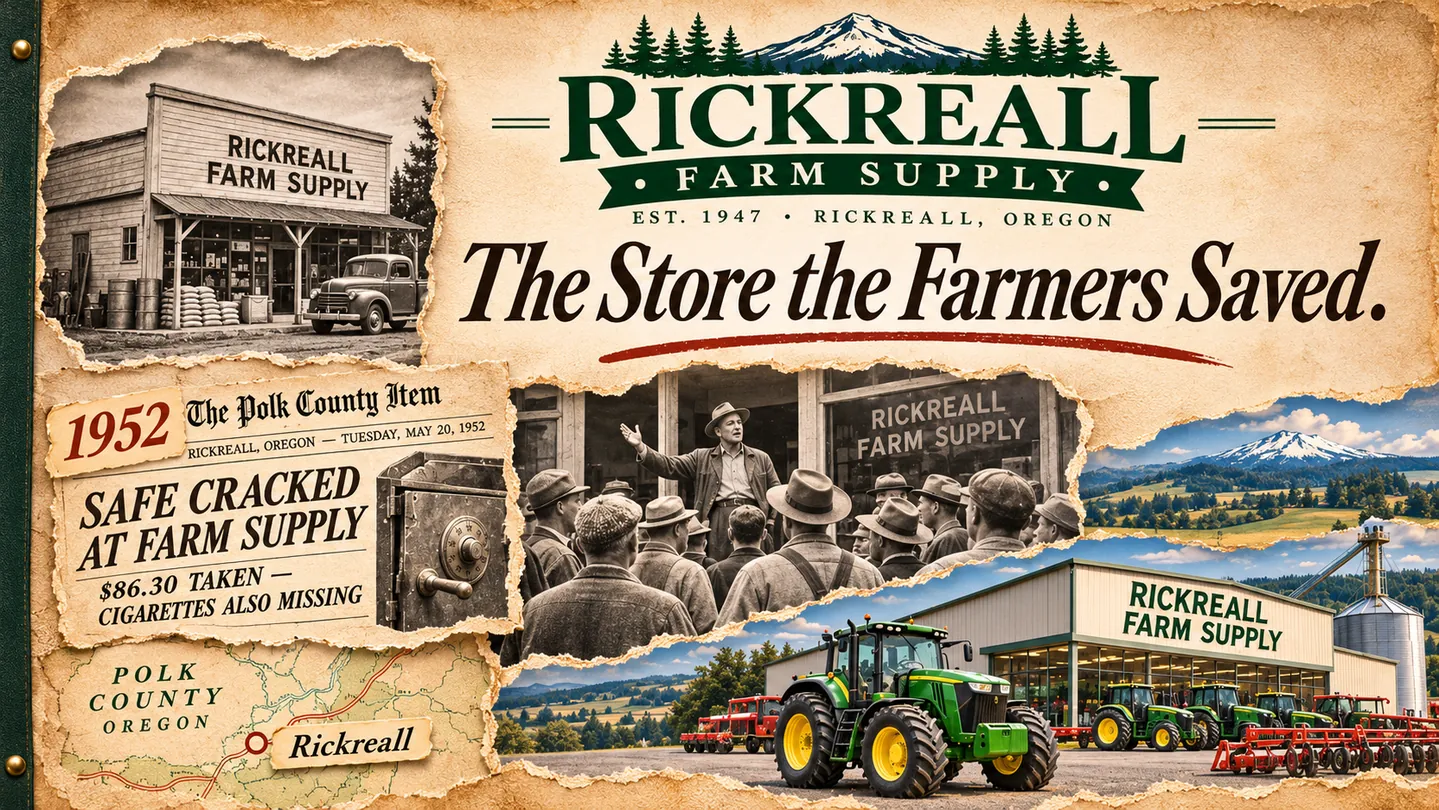
Someone forced open the safe and left with $86.30 and six packs of cigarettes. Two years later, the little Rickreall farm store would face a much bigger threat.
A safe, a pry bar, and an unexpected piece of history
On October 9, 1952, the Capital Journal carried a short report about the O.G.W. Farm Supply store in Rickreall. Someone had pried open a safe. According to the report, the intruders took $86.30 and six packages of cigarettes.
It is an unexpected opening to a dealership history: an ordinary rural supply counter, a physical safe and people getting ready to open the next morning. The clipping preserves a glimpse of the store in everyday life.
The short notice gives us a dated snapshot of the supply store, seven years before its modern company name became established.
In 1947, farm machinery had to catch up
Rickreall Farm Supply traces its beginning to June 1947, when Oregon Grange Wholesale, a Portland-based co-operative farm-supply organization, opened a branch in Rickreall. The company remembers the network had 27 branches throughout Oregon and that the store initially handled Massey-Harris equipment.
Farmers returning from the disruptions of World War II encountered equipment that often needed repair or replacement. That is how the company's own history explains the demand behind its early operation. In farm country, an unavailable part is not a mere inconvenience. Timing affects work, and work affects the next crop.
The dealership remembers the Rickreall branch began with just two employees. Whether they were sorting parts, answering calls or unloading machinery, their place in the story reminds us that the entire business once fitted into a very small staff.
The co-op disappeared; the town didn't want the store to
In 1954, Oregon Grange Wholesale faced liquidation. The Rickreall business's history says the organization's assets were to be liquidated by March 15. The branch could have ended as a consequence of financial decisions taken elsewhere.
A local answer to a statewide failure
O.G.W. Farm Supply operated twenty-seven branches in Oregon, according to Rickreall Farm Supply's published history. The Rickreall location opened in 1947 with two employees and a business centered on Massey-Harris equipment. Its first customers were farming families emerging from a war that had worn down machines and disrupted ordinary purchasing. Agricultural work had not stopped. Equipment needed attention, and replacements were not something every community could find around the corner.
In 1954 the larger O.G.W. organization liquidated. The local store might have disappeared with it. Rickreall's own account describes farmers and community members purchasing the inventory and establishing Rickreall Farm Supply as a separate corporation. What makes that moment unusual is the direction of the rescue. A dealer normally serves its customers. Here, the people who needed the dealer helped make it possible for the store to go on serving them.
That doesn't mean the business survived without later challenges or that everyone in town made the same choice. It means the community made an identifiable intervention at a moment when outside decisions threatened a practical local resource. They kept access to machinery and service nearby rather than accept a gap in the farm supply network. For an equipment history, that may be the most important turning point: the value of the store was demonstrated by the people willing to preserve it.
The founding narrative deserves to stay attached to its exact date and place. The store began as one branch of a network. It became independent because the network failed and neighbors acted. Those are different stories, and both belong in the headline. Read Rickreall's company history.
The stakes of the 1954 liquidation become clearer when you look backward. According to the dealership's own history, its Rickreall store began in 1947 as one of twenty-seven Oregon branches of O.G.W. Farm Supply, initially selling Massey-Harris equipment. Farmers had returned from the war and found their machinery worn out, outdated or in need of repair. The store was a practical answer to an urgent, everyday demand. It opened with just two employees.
When the co-op's parent organization had to liquidate, local farmers and neighbors purchased the Rickreall inventory and formed the new company. The significance of their decision was not a polished business slogan. It was that a farm community chose to keep a nearby source of equipment, parts and service in place. A business usually tells its survival story through the owner who kept it alive. This one has a more interesting answer: the customers helped become its rescuers.
The dealership’s history credits local farmers and community members with buying the remaining inventory and forming Rickreall Farm Supply, Inc. The Better Business Bureau records its incorporation on March 16, 1954.
The memorable part is the reversal: the people who needed the supply store became the people who preserved it. That is the beginning the dealership carries in its own history.
A store the community chose to keep
A supply store holds more than inventory. For the farms around Rickreall, it was a place to find equipment and keep work moving. The dealership’s account of the 1954 purchase makes that local value clear.
The people behind that decision deserve a place in the story. Their names and memories may still be in family albums or old business papers. What they kept going became the next chapter of Rickreall Farm Supply.
Where you picked up Christmas pageant tickets
By December 1957, a different kind of newspaper notice mentioned Rickreall Farm Supply. The Oregon Statesman named the business among the places distributing tickets to the town's Christmas pageant. That was a community performance, not an equipment promotion.
A parts counter and a place in the community
Sometimes the most persuasive evidence that a business mattered locally is a detail unrelated to sales. In November 1958, a newspaper announced Rickreall's annual Christmas pageant and explained where residents could obtain free admission tickets. One of the pickup points was Rickreall Farm Supply. The event had been rehearsed for weeks and was scheduled for three nights at the local school. Organizers asked anyone who could not use their tickets to return them so that another family might attend.
There is something affectionate about finding that announcement among ordinary news of the valley. A farm-equipment store was serving as a familiar, trusted location for a community event. It was not the organizer of the pageant, and the record does not say it financed the production. Its contribution was simpler: people knew where it was, and it could help distribute the tickets. That is how a business becomes part of the local map in ways not captured by a sales report.
Older newspapers can be tempting sources of romantic stories about small towns. This one does not require embellishment. It records a recognizable practical arrangement: a merchant's counter helped connect people to a free public gathering. When the story is about a store saved by its neighbors just four years earlier, that role carries special weight. The location remained useful to the community even when nobody was buying a tractor.
The headline about the pageant is a tiny piece of evidence, but it broadens the portrait. A business that supplied machinery also helped its neighbors coordinate something they valued together. See the 1958 pageant notice.
A November 1958 article again listed the dealership as a place to pick up free tickets for the annual pageant, alongside shops in surrounding communities. The paper described large audiences and the need to distribute tickets before the performance.
Imagine how many former residents remember the pageant more readily than they remember a particular tractor purchase. A ticket handed across a counter is the sort of humble historical detail that tells you what kind of social space a rural business could be.
A place to pick up parts was also a place to pick up Christmas tickets. The store had a place in the town’s everyday life.
In 1960, the store helped farmers vote
A July 18, 1960 edition of the Oregon Statesman offered another surprise. It listed sites where farmers could vote on wheat marketing quotas. For Rickreall and Dallas, the designated location was Rickreall Farm Supply.
The counter becomes a voting place
Two years later, another newspaper item put the store in a different kind of community role. A July 1960 report listed Rickreall Farm Supply as a location associated with a wheat-marketing referendum. Such votes mattered because agricultural programs affected how growers operated, planned and sold their crops. The dealership did not set the policy or determine how anyone should vote. It provided a familiar place tied to the people directly affected by the decision.
It is easy to overlook how often rural businesses perform tasks like this without becoming the center of the story. The meeting point might be a school, a post office, a grange hall or a shop where farmers are already accustomed to stopping. Rickreall had one of those places. The record is not enough to reconstruct the conversations that took place on voting day. It is enough to show the store's significance had become civic as well as commercial.
Placed beside the pageant tickets and the 1954 rescue, the vote gives the business a fuller shape. The shop was not merely a picturesque remnant of a slower era. It was part of the everyday infrastructure of a working community. People could repair machinery, exchange information about local happenings, and participate in decisions that reached beyond a single farm. Those things are not interchangeable, but they explain why the loss of a store could matter beyond the loss of its inventory.
The newspaper clipping cannot tell us every farmer's opinion. It can tell us something durable about a place that had earned a position in local life. Explore the 1960 referendum notice.
The same notice named Francis Farm Equipment in nearby Independence. It is a glimpse of the neighboring equipment businesses that served this farming community.
The voting location tells us something the store's equipment catalog never could. People knew where to find it, and it was considered a practical place to gather for a decision about the agricultural economy. A dealer's reach was both commercial and communal.
A long memory of different machines
The dealership's historical account lists a varied sequence of brands and equipment types: Massey-Harris, Massey Ferguson, Allis-Chalmers, New Holland hay tools, Versatile, Kubota and irrigation supplies. The exact mix changed as the decades passed.
The continuity has a surprising detail. Rickreall Farm Supply says it began selling Kubota tractors in early 1970, before Kubota Tractor Corporation's U.S. formation. The dealership identifies itself as the second-oldest continually operating Kubota tractor dealer among the remaining original American charter dealers. That claim comes from the company's history, but it fits the larger pattern visible in the records: the store survived by bringing different kinds of machinery to the same farming community as the work changed.
There is also something instructive about the address. The dealership says it has remained at the same Rickreall location since 1947. Seven decades of machines, different general managers, shifting brands and even a second location in Independence did not erase the original storefront's role. The farmers who saved it in 1954 could not have known every tractor that would someday be sold there. They only knew that losing the store would make the next breakdown harder.
The dealership’s history dates its first Kubota tractors to early 1970. It remembers those early years as the start of a long relationship with the brand.
A small store's service department has to adapt with these changes. An owner asking about a modern diesel machine faces a different set of parts and systems than a farmer who bought a Massey-Harris decades earlier. Yet the underlying question remains: will the machine be there when the work needs doing?
The Independence chapter, then home again
The company's history records a period when Rickreall Farm Supply operated an Independence location called Francis Farm Equipment, later combining that operation with the Rickreall store in 1980.
The Independence store became another chapter in the family of businesses serving local farms.
The store dates its Rickreall location to 1947. Its website preserves old photographs of the storefront and mechanics at work in the 1950s; the sources below link to that collection.
The history in the machinery and the people
Rickreall Farm Supply today offers tractors, compact construction equipment, implements, outdoor-power machinery, parts and service. The shop began as a branch of a co-operative system; it says local customers helped preserve the operation; and newspaper clippings show it participating in the life of its town in ways beyond selling machines.
A safe, a stack of Christmas tickets, a wheat-quota ballot and a line of agricultural equipment: the surviving records preserve an unusually rich picture of a working rural store.
Those objects would form the foundation of a real historical exhibit if the dealership and community contributed photographs or records. Even without them, the story is far richer than a corporate About page.
What we would ask someone who was there
Who were the farmers who helped purchase the inventory in 1954? Did the mechanics from the 1950s photographs stay with the new business? What do older customers remember about the first Kubota tractors? Is there a family album showing the 1954 changeover?
Family photographs, staff memories and old paperwork could fill in those chapters. Contributions from people who knew the store are welcome.
The Rickreall story is ultimately about local continuity. People kept the store when a parent organization dissolved, relied on it for machinery, and knew it as a familiar place to collect tickets and take part in the decisions of farm life.