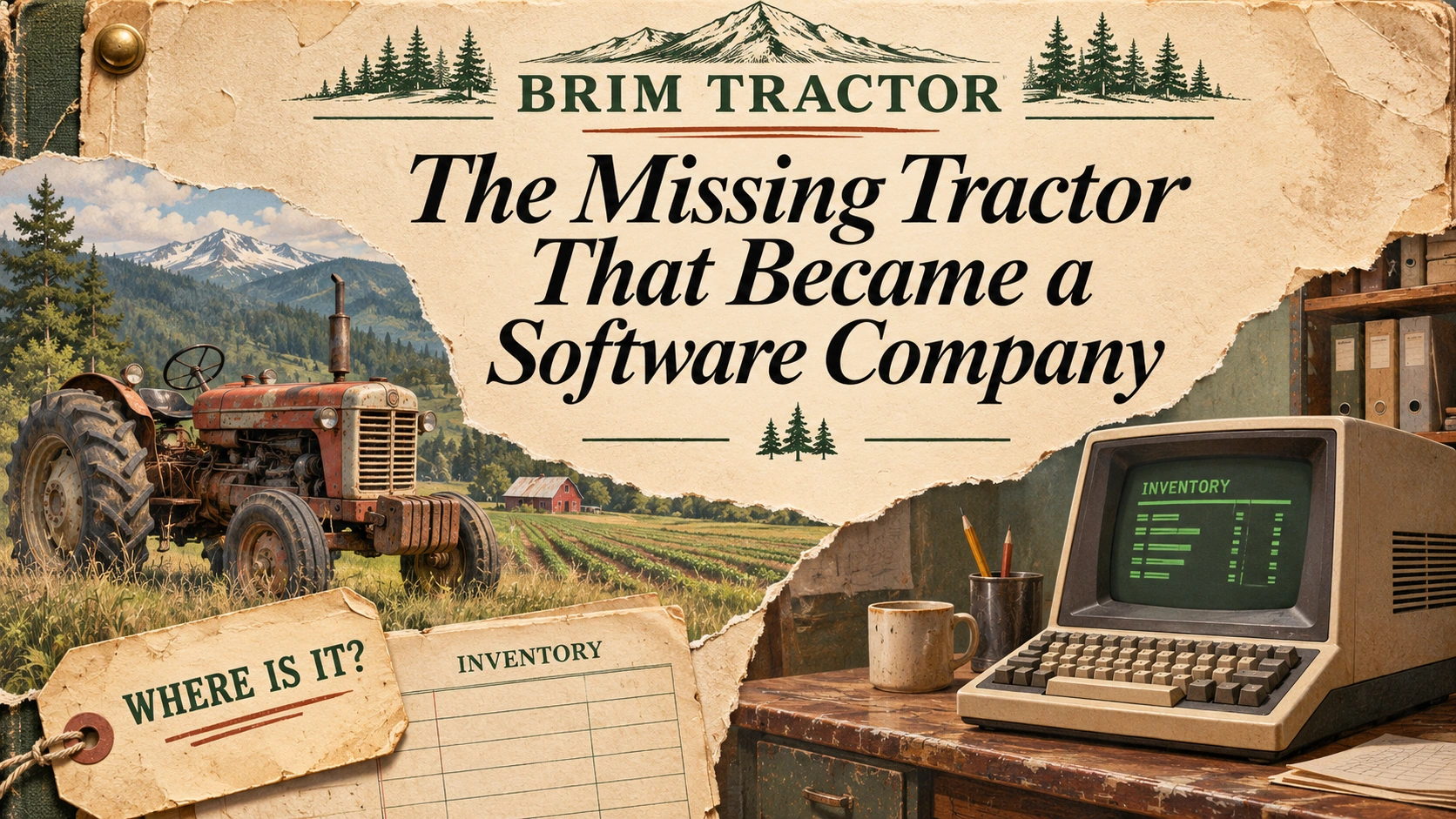
A tractor went missing at Brim Tractor. The answer eventually became another company.
That is how Dealer Information Systems tells its origin story: a problem in a Washington equipment dealership became the reason to write software. Somewhere between the machinery and the computer, the family found a second business.
First came the dairy farm
Bill Brim grew up on a dairy farm in Longview, Washington. At twenty-two, he became a part-owner of a tractor dealership. In 1966, Bill and Margaret Brim founded Brim Tractor in Lynden.
The first experiment was not a computer
The Brim family was already practiced at spotting equipment problems before Bob began writing software. Bill Brim had entered the dealership business at twenty-two. In 1966 he and Margaret established Brim Tractor in Lynden, in a region where farms needed reliable machines and where what worked in another country was not necessarily available from the local dealer. The family's history includes an early example of that restlessness: bringing a hydraulic-arm Bomford mower from England to the American market.
A mower on an articulated arm sounds ordinary once you have seen one maintain a roadside. The idea looks different if you think about the problem before the machine was available. Roadsides and embankments are awkward places for a tractor to work. The operator needs to cut beyond the wheel track, across uneven ground, while keeping the vehicle somewhere it can safely travel. The arm changes the relationship between the tractor and the job. That is a practical innovation, rooted in watching where the work is difficult.
The Centralia-Chehalis Chamber of Commerce, in a 2023 profile of the dealership, singled out the Bomford import as part of the family's wider influence on equipment operations. It is useful context for the computer story. Brim did not suddenly become curious when Bob found a missing machine on the inventory records. The dealership had already been built around the notion that a difficult, unglamorous problem might have an answer someone else had not brought to the yard yet.
That habit could lead to iron from overseas. A decade later it led to software written after hours. The materials were different; the starting question was much the same. Read the chamber's family history.
Bill also brought a hydraulic-arm Bomford mower from England to the United States. In the dealership's history, that import is one of the family's early contributions to the equipment business.
The useful thread is curiosity. A dealer has to notice what a customer is struggling to do, then recognize a machine that might make the work easier. Sometimes the answer is already being built on the other side of an ocean.
A physicist comes home
Bill's son Bob had studied physics and mathematics at Western Washington University and worked in Navy undersea research. He later earned a master's degree in electronic engineering at UCLA before returning to the family dealership.
The DIS account says the lost tractor prompted Bob to develop inventory software. Computer access meant nights at Western Washington, when the university's machines were available.
An engineer returns to a crowded equipment yard
Bob Brim's career made him an unusual person to find behind a tractor dealership's parts-and-inventory problem. His mathematics and physics education at Western Washington University had led to research work for the Navy, including projects connected with undersea decoy technology. He later studied electronic engineering at UCLA. The family business gave him something with far less glamour than naval research but no less demand for disciplined thinking: figuring out what was in stock and where it belonged.
Dealer Information Systems' account says the spark was a missing tractor. The word missing is important here. The company does not describe a dramatic theft or a vanished semi-trailer of equipment; it describes an inventory problem. A machine that cannot be reliably located in the records creates unanswered questions for the staff trying to sell, service or account for it. An inaccurate entry is not just a clerical nuisance when the product is expensive and other decisions depend on the same information.
Computer time was not something Bob could assume would be waiting in the family yard. DIS recalls him working through the night at Western Washington University because its computers were more readily available then. That is the part of the origin story worth holding onto: a technically trained man returning to a family dealership, borrowing access to computing power in the quiet hours, and trying to make the everyday workings of a machinery business intelligible to a machine.
There is no need to invent a conversation from those nights. The record already supplies the stakes. One dealership needed to trust its inventory, and Bob had an unusual set of tools for building that trust. Read DIS's account of Bob's beginnings.
It is a wonderfully unlikely combination: farm equipment, a university computer and an engineer who had already worked on problems beneath the ocean. The setting had changed. The habit of figuring things out had come home with him.
The solution leaves the yard
Ford Tractor endorsed the system for its dealerships, according to DIS. The software company dates its beginning to January 1980.
The business found traction beyond the family yard. Dealer Information Systems' own timeline records an outside investment in 1983 and a striking month in 1985 when it sold eighty-five systems. That year the company ranked number 118 on Inc. magazine's list of fast-growing businesses, according to DIS. From one tractor that could not be accounted for, the problem had become a business serving dealers who needed more reliable records of their own machines.
The problem was bigger than one missing tractor
The software's growth was not inevitable. An application useful in one family dealership still had to convince other owners, manufacturers and departments that computerized records were worth the upheaval. The DIS timeline offers some evidence of the distance traveled. In 1983, it recorded venture-capital investment. In 1985, the company sold eighty-five systems in a single month and appeared on an Inc. growth ranking. At that point the company was not merely keeping Brim Tractor's records straight. It was selling systems to dealers who had their own inventory and operational headaches.
The history also shows how quickly the needs widened. In 1986, Cummins selected DIS to create and support a communications system for its dealers and distributors. In 1991, AGCO named DIS among its preferred vendors. By 2001 the company was launching an internet-based dealership business platform, long after the earliest inventory program had become one chapter in a much larger product line. These are milestones in the company's published chronology, not a claim that every system was successful or every customer had the same experience.
Think about what an equipment dealership contains: a sales desk, a shop full of jobs in progress, a parts counter receiving orders, manufacturers asking for information, and customers who do not have time to repeat their history every time a different employee picks up the phone. Each department can maintain its own set of records, but the gaps between those records become a cost. The Brim software story resonated because the difficulty belonged to an entire industry, not simply one forgetful afternoon in Lynden.
The machine that set the story in motion never needed to become famous. It only needed to make the flaw in the system visible. Follow the company's published timeline.
Those figures do not tell us every reason the software succeeded. They do show how far the idea traveled. Bob had been solving an immediate problem for people he knew, using computer time borrowed in the quiet hours. A few years later, other dealerships were buying the answer. There is something unusually satisfying about that progression: the work began with an empty space in a tractor yard and grew because other yards had their own versions of the same problem.
Brim's own history credits brothers Bob, Alan and Dave with computerizing the dealership, and Bob and Dave with forming DIS to sell the software.
That is the remarkable turn in the story. Information about the iron became a product of its own. A tractor has an obvious physical presence: tires, engine, drawbar, a place in the yard. Keeping track of it requires something less visible, and the family had found a way to make that work better.
The family business keeps moving
The dealership continued through its own succession. Dan Brim joined in 1984. Alan bought the business in 1988, and Dan and Teresa Brim bought it from Alan in 1997. Expansion across the Northwest followed.
Those dates matter because the computer story could easily eclipse the original business. There were still tractors to sell and customers with work waiting. The software venture grew out of that practical world, while another generation carried on the dealership itself.
The software was only useful if it answered questions a busy parts counter or service department actually faced. Is that unit still in inventory? Which customer ordered the part? Where is the service history when someone else picks up the telephone? Today's DIS describes systems spanning inventory, parts, sales, service and accounting. That breadth is a later development, but the original insight still runs through it: information has to be available to the people trying to keep equipment working.
In other words, Brim Tractor's contribution was not that someone decided computers were fashionable. It was that a dealer knew the cost of uncertainty. When the missing tractor became a software problem, the Brim family treated an everyday inconvenience as something worth solving at its roots. The result reached well beyond Lynden, even as the original dealership continued to serve the people who needed tractors, parts and repairs.
A family business can have more than one kind of inheritance. There is the company, and there is the tendency to spot an awkward problem and start making something.
Then the parts counter went online
The family returned to that same territory with PartSpring, an online parts business launched by Dan and Steve Brim. In an account introducing its successor, BRIM:Parts, the dealership described serving buyers in all fifty states.
Two businesses, one family test
It would be easy to tell this as the story of a technology company escaping the tractor yard. That would miss what happened to the yard itself. Bill and Margaret's son Dan joined Brim Tractor in 1984. Alan purchased the dealership from Bill in 1988. In 1997 Dan and Teresa purchased it from Alan, keeping the machinery business in the family even while the software venture followed its own path.
The dealership's history records subsequent expansion: Burlington New Holland joined the business in 2000, with additional branches following in the early 2000s. Those dates belong to the company's published account and do not establish its present branch count. They do establish that the family was still doing the original work: handling machines, parts, repairs and relationships with customers whose livelihoods depended on equipment working when needed.
Then came another experiment that looks smaller from a distance but is just as recognizable to a working customer. The family's online parts ventures allowed someone far from the dealership to look for what they needed without standing at its physical counter. As the catalog changed, the problem changed with it: buyers needed the right model and serial information, parts that could be identified accurately, and a website usable on a phone. The company described BRIM:Parts as the successor to an older online store, with a wider catalog and updated shopping experience.
The continuity is striking. First the family imported a machine designed for a difficult roadside task. Then they helped make dealer records searchable. Then they made equipment parts easier to find from beyond the yard. None of those answers removed the need for skilled people. Each was a different way of connecting a person with the exact thing needed to get back to work. Explore the Brim family timeline.
The replacement site addressed a familiar problem: an early online store had aged. Customers were now shopping on phones, and the catalog needed room to grow. BRIM:Parts added Yanmar tractor parts and Braber hardware and linkage alongside New Holland parts.
A parts counter and an online catalog solve much the same human problem. Someone needs the right piece to put a machine back to work. The distance between that person and the shelf has changed. The urgency has not.
The machinery you cannot see
Walk into an equipment yard and the machines make the first impression. Their size almost guarantees it. The quieter questions take longer: Who knows its history? Can the right part be identified? Does the information follow the machine when someone else answers the phone?
For a buyer, those questions belong beside horsepower and price. Ask how records, parts and service will work after delivery. Bring the exact model and serial number into the conversation early.
Brim's history offers an unusual way to remember that. The tractor was the visible asset. The system built to keep track of it became an asset too.
What an inventory system cannot replace
There is an irony in a story that begins with an unaccounted-for tractor and grows into a software company. Machinery dealers exist in a world of physical, stubborn things. A broken hydraulic line still needs replacing. A tractor must still be hauled to the customer. A mechanic still has to diagnose the noise or leak that no spreadsheet can mend by itself. The computer does not make any of that disappear.
What good information can do is make the human work less blind. It can tell a counter worker which component belongs on a particular machine, help a service department know what has already been tried, and keep a salesperson from promising a unit that another customer has bought. In that sense the technological accomplishment was an act of respect for the people doing the less celebrated labor around the machines.
The Brims turned one problem into a business that served other dealerships. But the most useful inheritance may be the question behind the technology: when the next problem turns up at the shop, will someone pay close enough attention to it to create a better way?