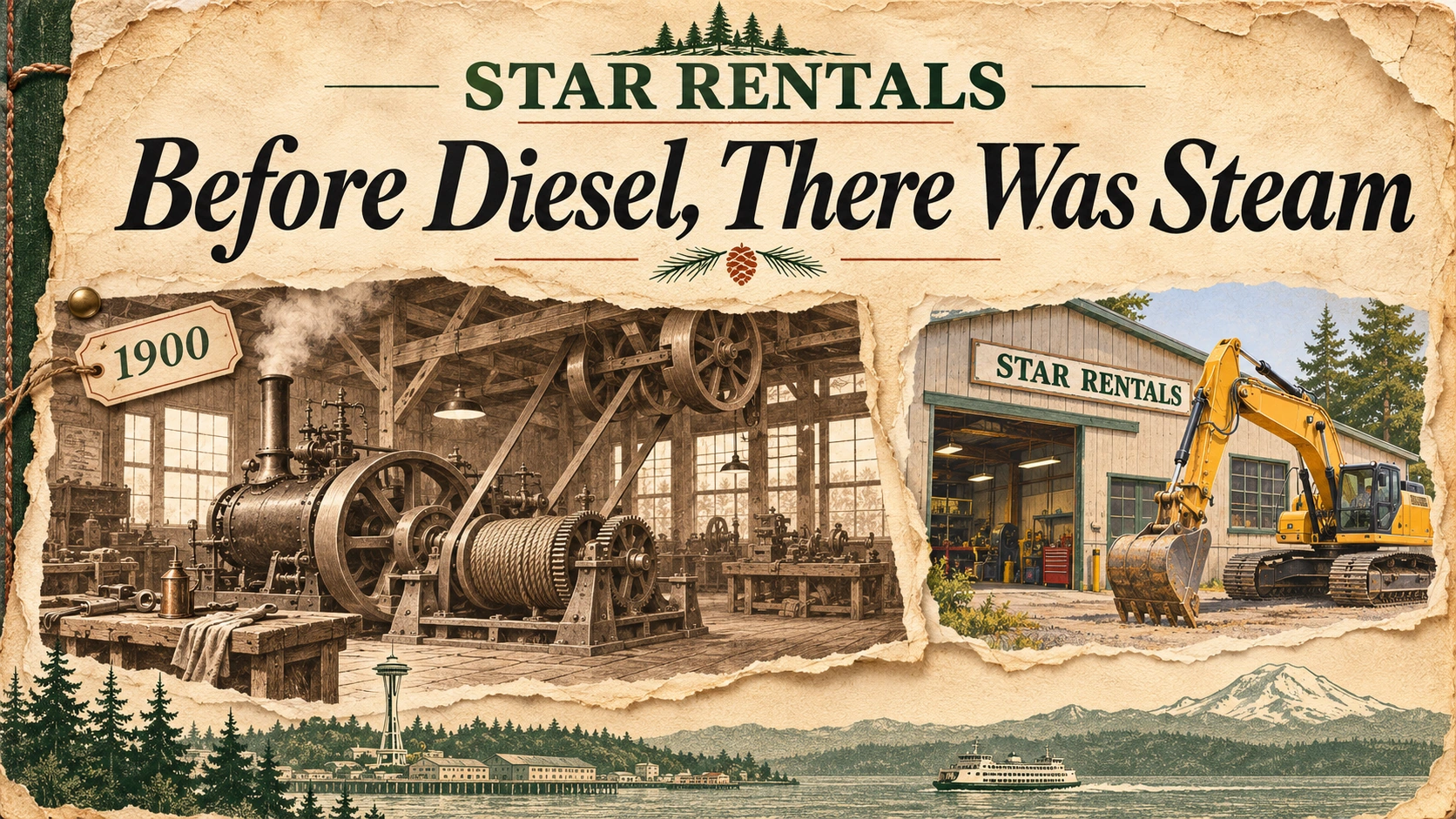
Before there was a rental counter, there was a man who could get a sawmill running again.
Christian Rabel's story leads from steam engines and rebuilt boilers into Seattle's machinery trade. Follow it far enough and the evidence changes shape: a large star on a warehouse, a crane inside the building, a short announcement about eighty employees sharing in the profits. The modern Star Rentals name carries a much older working history.
A useful skill becomes a business
Rabel, an immigrant from Germany, worked in the sawmill business and became skilled at repairing its steam-powered machinery. A 2017 Rental Equipment Register profile recounts the progression: fixing mills, purchasing used boilers, rebuilding them and growing a machinery business.
The machinery was already somebody's livelihood
Long before a rental truck left a Seattle yard with an excavator, the people building the Pacific Northwest depended on machinery that could fail in the middle of a workday. Sawmills needed engines, boilers, belts and people who could make them work together. Christian Rabel learned that world from the repair side. According to a 2017 Rental Equipment Register profile, he became so adept at fixing machinery that he began working on other mills and eventually purchasing used boilers, rebuilding them and returning them to service.
It is a wonderfully concrete origin story. A steam engine is not useful because it looks impressive. A mill can only turn logs into lumber when the power is there and the mechanism works. Rabel's skill had value because a stopped machine imposed a practical cost on everyone waiting downstream. Repair knowledge could become an independent business long before rental contracts and digital dispatch systems existed.
Star Machinery's early market followed the region's work. The company's trade history describes customers in logging, mining and fishing, with business reaching as far as Alaska. Those are not interchangeable industries. A fisherman, a logger and a miner might need different machinery, but each depended on suppliers who understood the demands of the job. The business's later move toward construction equipment was another adaptation rather than a break with its beginnings.
What carried across those industries was not a single product line. It was an operating instinct: keep useful equipment available, and understand what the customer will lose if the machine cannot do its work. Read the early company history.
Star's own history dates the company's launch to 1900. The trade profile records its incorporation as Star Machinery in 1901. Those dates describe two moments in the same beginning: a working enterprise taking on a formal corporate life.
It is a wonderfully practical origin for an equipment company. The starting point was knowing what to do with machinery that needed attention. The ability to make something work again became something people could build a business around.
A star above the crane
Seattle's historic-building inventory preserves another piece of the story at 1741 First Avenue. The Star Machinery warehouse was constructed in 1921 in the city's former tidelands, an area made available for rail, port and industrial development through years of filling and grading.
Its original front had a gabled section with a large star. Behind that portion of the facade, steel trusses supported a space containing an electric crane. The building's structure tells you what kind of business belonged inside: heavy things had to arrive, move and leave again.
Later alterations changed the building extensively. Yet the old inventory description keeps that star and crane together on the page. One announced the business to the street. The other did the lifting.
The shop by the railroad tracks
A second city record leads to 207 South Horton Street. By 1936, Star Machinery was using the building as a machinery shop within a larger complex.
The survey describes a heavy-timber building approximately 70 feet wide and 161 feet long. Its west side faced railroad tracks. A raised central roof admitted light through rows of windows, above an interior supported by substantial timber framing.
The addresses remember a working city
The history of an equipment company can survive in places where nobody thought to write a biography. Seattle's inventory of industrial structures describes the Star Machinery warehouse at 1741 First Avenue South, built in 1921 on land that had been part of the city's tidelands. The building had a star displayed on its front and an electric crane supported inside by steel trusses. There is no need to invent a scene to make that picture vivid. The company's identity was literally on the building, and its equipment had to move through the space behind it.
At another address, 207 South Horton Street, a wooden shop ran along railroad tracks. A high central roof brought light into a long interior framed with heavy timbers. Those design choices told visitors what the business required: a place to receive bulky machinery, work on it and send it toward its next owner or user. Tracks, lifting equipment, light and floor space were part of the service, even when customers came looking for something with an engine rather than a building.
It is tempting to think of an equipment company as the sum of machines parked outside. The warehouses tell a more complete story. Someone had to unload them. Someone had to inspect, repair and move them. A business could sell products across a wide region only if the unglamorous work inside the building made that possible. The old shops made an entire chain of labor visible, from the people lifting machinery onto a vehicle to the customer waiting at the other end.
Buildings change owners and uses; historic inventories do not preserve every shift or every worker. They do preserve the physical evidence of what an industry needed. In Star's case, the star on the facade and the crane behind it are more than atmospheric details. They are two parts of the same promise: here is a place equipped to deal with heavy work. Explore the city inventory.
Those are ordinary architectural details, but together they restore some scale to the name. This was a business with enough machinery work to occupy a long industrial shed beside the tracks. The history lives in working space as much as in a list of anniversaries.
Eighty people in a small news item
In December 1940, Western Construction News published a brief announcement from Star president O. R. Rabel. Permanent salaried employees would participate in a profit-sharing plan, with bonuses determined quarterly using profits from the preceding six months.
About eighty employees were expected to share in that year's fourth-quarter distribution. The same notice said Star represented ninety-four manufacturers and identified Christian Rabel and his son as its founders.
The number has a human scale that is easy to miss on an old trade page. Eighty employees meant more than eighty names on a payroll: mechanics, office staff, people handling orders and equipment, and the families who depended on work continuing. The 1940 notice did not name them or describe the amount any individual received. It did record a decision to tie employee bonuses to the company's profits, calculated quarterly from the preceding six months.
The same item said Star represented ninety-four manufacturers. Put that beside the proposed profit-sharing plan and the scale becomes clearer. What began with one person's skill repairing machinery had become an organization coordinating products and people from across the equipment trade. The old star painted over the warehouse door was a company mark. The more consequential story was the growing group of workers whose effort made that mark mean something.
It is a small item in a magazine crowded with equipment news. That is what makes it revealing. Between the machinery appointments and product announcements sits a glimpse of the people whose paychecks depended on keeping the business moving.
The company had grown far beyond one man's repair skills. Its story now included a substantial staff and a remarkable number of manufacturers.
A business of eighty paychecks
A machine has a make and model. An employee has a name, a trade and a life outside the shop. The old newspapers rarely preserve those individual stories in equal detail, but sometimes they reveal the organization surrounding the equipment. Star's December 1940 announcement said approximately eighty permanent salaried employees would share in its profit-distribution plan. The bonus was to be calculated quarterly from profits earned during the preceding six months. That policy existed in a business representing ninety-four manufacturers, according to the same notice.
The announcement does not tell us what each employee received, and it would be wrong to turn a short trade item into a grand claim about how everyone felt. What it does show is that a machinery operation had become a substantial local employer and that its leadership was publicly describing a relationship between the company's performance and its workforce. That is a different scale of enterprise from a man working out how to repair a sawmill engine.
The detail makes the family history more complicated, and more interesting. The Rabel name continued, but a company supplying equipment across multiple industries depended on more than a founder's expertise. It needed mechanics, warehouse workers, buyers, salespeople and employees who could keep up with dozens of product lines. The organization had grown bigger than any one person could repair, inspect or explain alone.
For all the machinery shown in an old dealer photograph, the payroll is the part of the history most likely to remain invisible. It deserves a place in the story because it shows how an individual's skill became work for many other people. The shop did not simply survive; it built an institution around the need for capable hands.
The name at the counter changes
Star Rentals emerged in 1960. Decades later, the equipment yard faced a familiar problem: there was no longer enough room to move comfortably.
The rental counter was somebody else's idea
The Star name was already decades old when the rental business began to take its recognizable form. A 2002 Rental Equipment Register history identifies Kyle Hesse, who had worked in equipment rental elsewhere, as the person who approached the Rabel owners in the late 1950s. There was already a small rental operation tucked behind the machinery business. Hesse saw the possibility of making it something more substantial. The family agreed to retain ownership while he ran the new venture.
That decision has a different shape from Rabel's original repair business. Instead of selling a machine to one owner, the company could make the same machine available to several customers at different times. Doing that well required its own expertise. The machine had to return, be checked, serviced, stored and prepared for somebody else's job. It also had to be delivered, picked up and documented without keeping a crew waiting. These duties might look ordinary from the counter, but they made the model work.
Hesse led the rental company until his retirement in 1997. Bob Kendall, whom he had hired in 1983, succeeded him. The transition is an overlooked part of the family-business story: the Rabel family did not have to fill every leadership role with a relative to keep its identity intact. It could make room for people with deep operational knowledge and give them responsibility for the next phase of the business.
Star Rentals' significance lies partly in that shift. The original company knew how to repair machinery. The rental division had to turn that knowledge into readiness, day after day, for customers whose needs changed. The strongest link between the old shop and the new counter was service, not a particular piece of iron. Read the account of the rental division's beginnings.
The 2017 trade profile describes the move from Seattle to a 3.5-acre Kent headquarters with a 17,000-square-foot building. More space let trucks and equipment circulate more easily.
The geography of getting a machine to work
The relocation to Kent supplies one of the most revealing modern chapters in the story. The 2017 Rental Equipment Register feature described the previous Seattle headquarters as an 8,400-square-foot building on less than an acre. After years of growth, the yard had become so crowded that employees had to move machines simply to reach other machines. An operation built around getting equipment to customers was losing time before the deliveries even began.
Bob Kendall, the company's president at the time, described the traffic problem in equally concrete terms. A twelve-mile delivery to the University of Washington could take roughly three hours in heavy traffic. The company needed extra trucks and equipment to compensate for the hours lost on the road. The problem was not that its machines could not do their jobs. It was that the city had made it harder to get those machines to the jobs where people needed them.
For the new headquarters, the company selected about three and a half acres in Kent with a building of roughly 17,000 square feet. That meant space for equipment to arrive, be worked on and leave without every movement interfering with another. The report also noted that many employees lived south of Seattle and would have significantly shorter commutes. The business's physical layout was changing not merely for appearances but to make work easier for drivers, yard crews and customers.
The story circles back to the first machinery shops. In 1921 an overhead crane moved heavy equipment inside a warehouse; almost a century later, a larger yard let multiple trucks load without blocking one another. The city, machines and delivery schedules had changed, but the engineering question was familiar: how can the operation be arranged so the people doing the work spend less time waiting? Read the Kent relocation report.
The equipment yard had changed, but the underlying challenge had not. In 1921, Star needed an overhead crane to move weight through a warehouse. Nearly a century later, its Kent facility gave returning equipment and outgoing trucks room to circulate. Different machines demanded different spaces, yet both buildings were designed around the same requirement: get working equipment where it is needed without losing the day in the process.
A city usually remembers the finished building or road, not the machine that arrived for a few days and then went somewhere else. That is the quieter role of a rental company in a regional economy. Contractors can use specialized equipment for a particular task without owning an entire permanent fleet. Star's century-long shift from rebuilding machinery to sending it out to customers belongs to that larger history of how work gets done.
Before the equipment could get to somebody else's job, it had to get out of its own yard. That ordinary obstacle offers an unusually good way to picture the business: working machines, arriving and leaving, all day.
The useful part of a long history
Today Star operates as Star Rentals and offers used equipment for sale alongside its rental business. Its sales categories include forklifts, generators, loaders, excavators and aerial lifts. The connection to the machinery trade remains tangible.
Two minutes at the gate
There is a small scene in a 2002 trade profile that does as much to explain Star Rentals as any anniversary timeline. A customer called a Seattle branch to say he would be picking up a rotary hammer. When he arrived, the branch manager recognized the company truck, retrieved the customer's information and had the paperwork ready. Another employee loaded the hammer. The article reported a visit lasting less than two minutes inside the gate. It was one example recorded by a journalist at the time, not a guarantee of how every rental transaction worked.
The same article described a contractor arranging to pick up a generator at half past five the following morning. The contract was prepared the night before so the customer could move quickly. A third visit involved an air compressor and rock drill, handled in about five minutes. The equipment was unremarkable compared with a massive crawler tractor or a crane. That is precisely why the examples matter. Most customers are not coming to a yard for a dramatic machine; they are trying to get one useful tool to a real job before their crew loses time.
In that report, Kendall explained the operational thinking behind the quick turnaround: the arrangement of the yard, its shelves, its counters and its information systems all had to support the person arriving at the gate. The company was treating the customer's waiting time as something worth engineering away. A strong rental business cannot be reduced to the age of its fleet or the number of machines on a website. The experience depends on whether the people, tools and routines around those machines are ready.
That gives Star's long history a human ending. The steam machinery that Christian Rabel repaired would eventually give way to many different products. But the reason to repair a boiler and the reason to prepare a generator for an early-morning pickup are closely related. Somewhere on the other side of the transaction, people are waiting to work. Read the recorded customer-service scenes.
For someone choosing equipment, the old story offers a good starting question: who understands this machine after the transaction? Ask about maintenance, service records and the work you expect it to perform.
The machine may have changed from a steam engine to an excavator. The value of someone who understands how to keep it working has a much longer life.