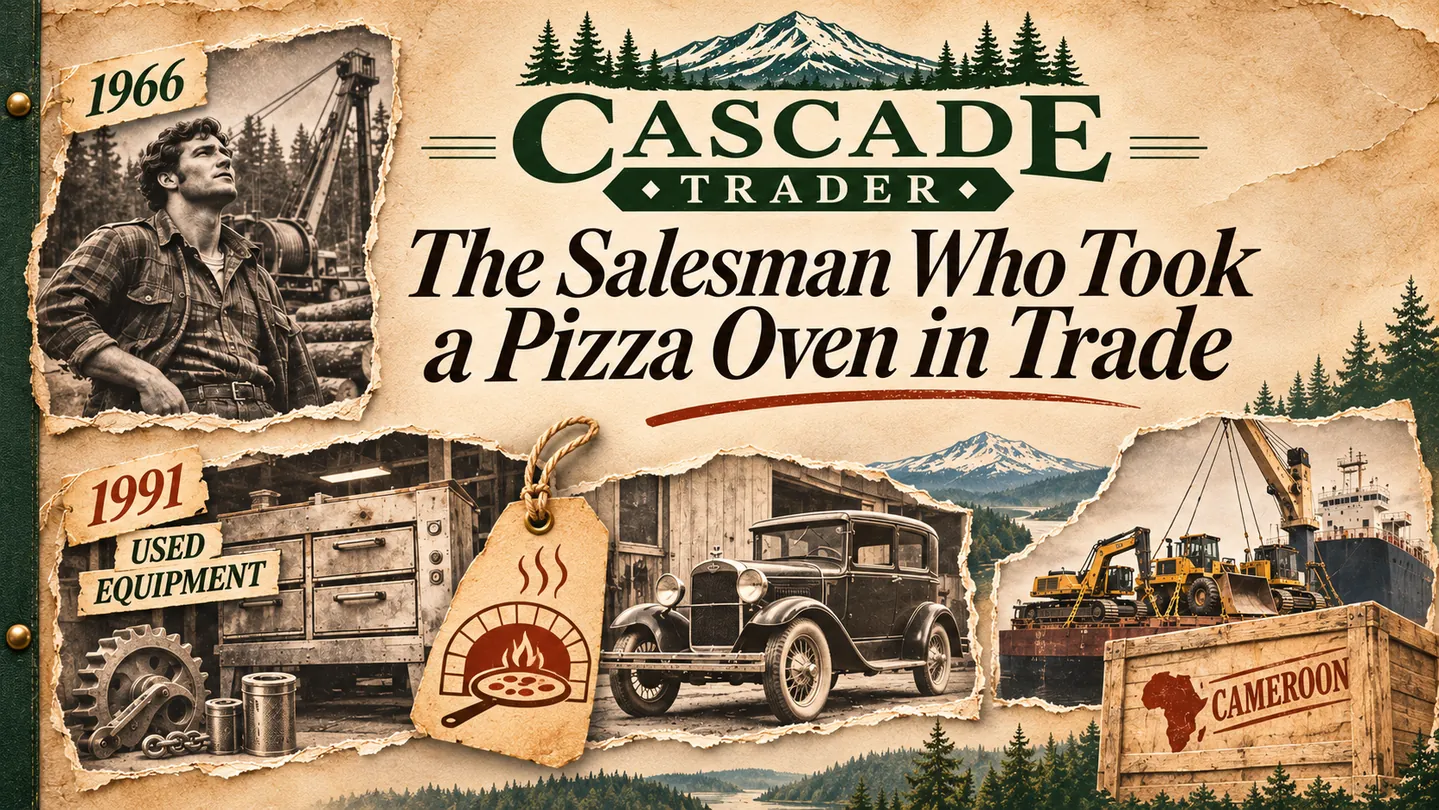
At some point in his long career selling logging machinery, Rich Lennox ended up with a four-door pizza oven. Not because he planned to open a restaurant. He took it in trade. By 2016, he had been trying to sell it for five years. A business that can end up with a pizza oven, a Model A Ford, and a $1.7 million order headed for Cameroon is clearly worth a closer look.
Why is there a pizza oven in an equipment story?
The most entertaining clue in Cascade Trader's history has nothing to do with horsepower. When a Chehalis newspaper profiled the company in February 2016, Rich Lennox had a confession: he had accepted a four-door pizza oven in trade and couldn't find anyone to buy it. He had been sitting on the thing for years.
The oven wasn't the only unconventional deal. Property, a Model A Ford and other classic cars had all found their way into Lennox's trades. It was the kind of business where the word trader meant something more literal than a name on the sign.
Imagine trying to explain a four-door pizza oven on the same balance sheet as a multi-ton forestry machine. It's funny, but it also says something real. Buyers in the woods didn't always arrive with a neat bank check and a polished plan. Sometimes the deal was possible only because somebody was willing to think creatively.
Before the trading, he learned to sell iron
Lennox began his machinery career at Skagit Manufacturing in Sedro-Woolley in 1966. There was a lot to learn. Logging machinery works in steep country, deep mud and places where a repair truck may have a long drive ahead of it.
His experience at Skagit eventually brought him to Chehalis and into close contact with loggers. In the 1970s he started Cascade Loggers Supply, concentrating on the machines and supplies the trade needed. Refurbishing and reselling used logging equipment became an important part of the business.
A good salesperson in that world learns more than catalog numbers. He has to know the job a machine is meant to do, what happens when it stops, and which customer is trying to stretch an old machine through one more season.
A business built around the word trader
Cascade Trader began in 1991 with an emphasis on pre-owned machines. Its first crew was small: Lennox, his daughter and a mechanic. A few people, a lot of equipment knowledge and a willingness to make deals others might consider unusual.
Used logging iron is never a blank slate. A machine has already been dragged across rough ground, loaded, repaired, worn, sometimes abused, and then offered to the next buyer. Selling it takes judgment. It also takes a sense of what kind of buyer can put it back to work.
As the business grew, it began carrying newer machinery and a broader selection of attachments, repairs and service. The trading never entirely left the culture. That story about the pizza oven is proof.
The family at the yard
By 2016 the company had grown to about twenty-five employees. The Chronicle counted Lennox's wife, three daughters, two grandsons and a son-in-law among them. Rich joked about the amount of family hiring with a line short enough to make the whole newspaper profile memorable: "Nepotism is run amok here."
The scale of the business in 2016 is worth setting beside the pizza oven. In a Chronicle profile that year, Rich Lennox described a company that had begun with himself, his daughter and one mechanic. It had grown to twenty-five employees, including his wife, three daughters, two grandsons and a son-in-law. He joked about the family connections. The machinery outside was enormous, but the business was held together by people who knew one another's work.
Lennox estimated that roughly seventy percent of sales came from within seventy-five miles of Chehalis. The rest could travel much farther, including the much-discussed $1.7 million transaction involving four machines sent to Cameroon. Those figures are a 2016 snapshot, not a description of the dealership's present size. They reveal a distinctive balance: a regional shop that needed to be reliable to the crew down the road, while still capable of putting equipment on the other side of the world.
The joke worked because the shop was obviously doing serious business. There were mechanics modifying equipment for different customers, workshops able to handle several big machines and people on the road trying to keep customers working.
A family operation at that scale has its own challenges. The people at dinner may also be the people on a service schedule. They have to get along when the machinery breaks, the shop gets busy and the phone won't stop ringing.
Four machines to Cameroon
Most of Cascade Trader's work was regional. In 2016, Lennox estimated that about seventy percent of business came from within seventy-five miles of Chehalis. Yet the machines had traveled much farther than that.
A few years earlier he had arranged a roughly $1.7 million sale involving four machines headed to Cameroon, Africa. Four pieces of working Northwest iron, crossing an ocean for jobs on another continent.
The company was still known for the familiar equipment yard near Chamber Way and State Avenue, but its customers and machines had grown well beyond a local map. That gap between neighborhood relationships and international machinery is one of the surprises hiding behind the modest name Cascade Trader.
Nineteen machines for one customer
The same 2016 profile described an Oakville-area business, Willis Enterprises, acquiring nineteen Doosan machines through Cascade Trader. That is a very different challenge from finding one used machine for a small contractor.
Cascade Trader had begun representing Korean-made Doosan equipment around 2005, when the brand was unfamiliar to many customers in the region. Lennox had made a bet on it, watching reliability, parts availability and operating costs as the machines earned their keep.
A large fleet order made the bet visible. It takes more than getting the equipment across the yard. Training, parts and field service have to work after delivery, because nineteen machines can mean nineteen opportunities for a contractor to lose time.
The warranty that put the dealer on the clock
In 2016, Cascade Trader described a forty-eight-hour response promise on its new equipment: repair or replace a broken part within two days, or provide a temporary machine while a fix was underway. The shop had five road-service trucks that were almost constantly moving.
The same reporting describes a promise that put a very short deadline on service problems. Lennox said a qualifying machine problem would be fixed or addressed with a replacement within two days. That was a statement made in 2016, not a present-day warranty offer. But it helps explain why his customers were buying more than metal. When a logging machine stops, the crew, trucks and work waiting behind it can stop too. A dealer who understands that delay is selling a response as much as a machine.
That also changes how to read the strange trade-ins. A Model A Ford or a pizza oven could be an entertaining curiosity, but the reason the name Trader mattered was that Lennox was willing to consider what the customer actually had. In the Chronicle's account he talked about helping buyers he knew and earning their return business. The unusual trades were not separate from the dealership's practical reputation. They were part of the same instinct: find a way to keep the next job moving.
In that 2016 account, the promise put the dealer on the same clock as the customer. A broken machine could be a long way from the yard, but the job still needed to get moving.
Lennox had a practical understanding of the stakes. A logger stuck in the woods is not waiting around cheerfully for a callback. The job is stopped, people and machines are idle, and every hour matters.
The year the yard got too full
By the time of the newspaper visit, Cascade Trader was selling an estimated sixty-five to seventy new machines per year. Lennox described having roughly a year's worth of machinery on hand. The storage lots, workshops and main site were all part of a business that was outgrowing its space.
But he didn't want to abandon the familiar corner where loggers already knew how to find him. Other equipment-related businesses were nearby. The location had become part of the way customers shopped.
There is an almost comic contrast here: a man worrying about too much inventory, who had also acquired a pizza oven he couldn't move. The machines might be enormous, but the decisions still came down to judging what someone else would buy.
The logger whose father went there too
Fast-forward to a 2023 forestry-magazine profile of Chehalis logger Charlie Alexander. He worked largely alone, running a mix of logging, mulching and road-building tasks in the forests around southwest Washington.
The machine that had to replace a loss
One of the strongest accounts of Cascade Trader comes from someone who was not trying to write an anniversary tribute. In a 2023 TimberWest profile, Charlie Alexander of CBA Logging described working as a one-person operation around Chehalis. He also worked at a power plant, logged in his available time, and took on work that could range from brush mulching to road building. His equipment mattered because he did not have a large crew to absorb every delay.
Alexander had been buying equipment from Cascade Trader for years. His father had dealt with the same company before him. That is the family connection behind the article's most affecting detail: an equipment relationship that lasted long enough for two generations of loggers to know the same dealer. Trust here was not a commemorative word printed on a website. It could be tested in the middle of a very practical problem.
After an earlier machine burned, Alexander needed a replacement capable of helping him clear brush, maintain right-of-way and work on his own tree farm. Working with Rich Lennox, he explored an FAE PT-300 tracked carrier. A representative from FAE described arranging for Alexander and Lennox to visit the company's operation in Georgia so Alexander could try the machine before taking delivery. That journey tells us more about the dealership than a catalog ever could: the dealer accompanied the buyer to examine whether the machine would fit the work.
The story also makes room for the owner-operator himself. Alexander was not presented as a passive recipient of advice. He knew the terrain, the work and the equipment he had already used; the dealer and manufacturer helped him evaluate a different approach. The resulting sale mattered because it answered a real problem after a loss. It is the kind of relationship a family equipment business hopes to earn, but one that has to be demonstrated through actions, not claimed in an advertisement. Read the 2023 TimberWest profile.
Alexander had bought equipment through Cascade Trader for years. His father had done business there too. In a region where machinery can be passed around and repaired long after the factory stops making it, that sort of continuity means something.
Alexander had grown up around logging, helped his father when he was young and eventually built a working life around machinery. It wasn't just a name on a customer list. The dealer had been part of the family's equipment story for two generations.
After the fire, a trip to Georgia
One of Alexander's machines had burned. Its replacement wasn't a simple matter of choosing the newest model with a bigger number on the hood. He wanted something that would make his work faster and more productive.
Rich Lennox and an FAE representative became part of that search. Alexander and Lennox traveled to Georgia to see FAE's U.S. operation and try the tracked PT-300 carrier for themselves. A Chehalis logger, a Pacific Northwest dealer and an Italian equipment maker had converged around one practical question: would this machine do the work?
The machine ultimately became part of Alexander's one-person operation. His work included clearing land, managing vegetation and leaving a site in good condition after the job. It was another equipment purchase, but the details made it personal.
The same handshake, a different machine
Cascade Trader's story can be measured in dates: Skagit in 1966, the supply business in the 1970s, the dealer founded in 1991, the larger machine network that followed. It can also be measured in stranger things: a Model A Ford, a pizza oven, four machines shipped to Africa and a family that kept returning.
Machines don't last forever. They break, burn, wear out, get traded or move to another owner. The people who helped with them can stay in a family's memory for decades.
In a yard full of iron, the most durable thing Cascade Trader may have built is the relationship between the person with the problem and the person willing to help solve it.