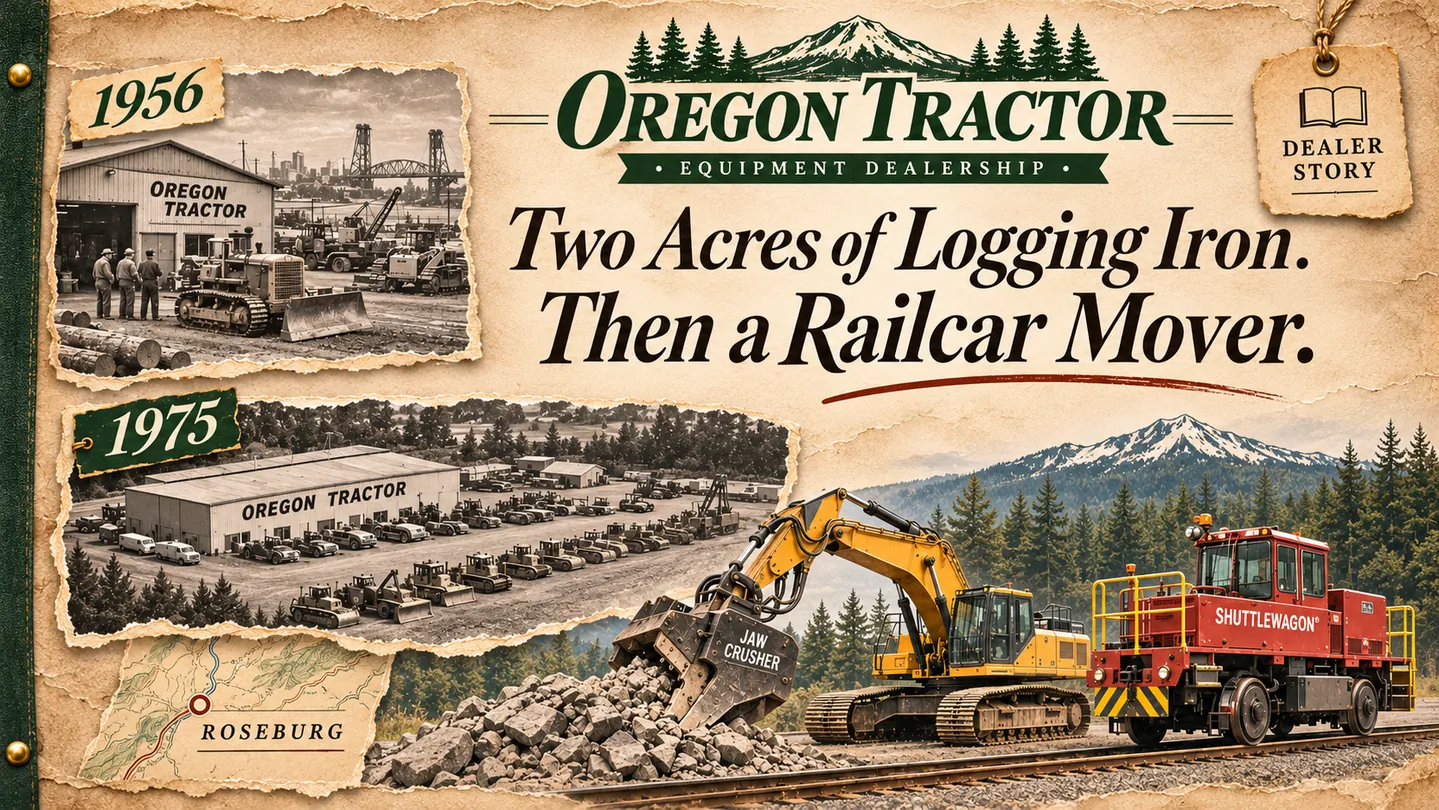
Look closely at an orange equipment advertisement from 2011 and you find an unlikely machine beside the excavators, bulldozers and loaders: a mobile railcar mover. The dealer offering it was Oregon Tractor. A business that started with used logging equipment had become a place where the machinery might dig a hole, crush concrete, or move a railroad car.
The unlikely machine in the 2011 advertisement
The 2011 membership directory for Oregon's utility and excavation contractors contains an Oregon Tractor advertisement bright enough to stand out from the surrounding pages. There are pictures of excavators, loaders, a crusher and a giant-looking collection of working machines. And along the bottom are manufacturer logos that tell a bigger story: Liebherr, Hyundai, MB and Shuttlewagon.
Most people recognize an excavator. A mobile railcar mover is a different animal. Instead of digging or lifting dirt, it is designed to move railcars around industrial tracks. Why would a tractor dealer be offering equipment like that?
Because the needs of working customers don't always fit neatly into a category. The company that began with used logging iron eventually helped buyers think about material handling, crushing and even moving railcars. The machines were different. The question underneath them wasn't: what do you need to get done?
A two-acre beginning in 1956
The story begins in 1956, with a family-owned company selling used logging and construction equipment on a two-acre property in Portland. Picture a yard full of machines that had already lived other working lives. The paint was not necessarily fresh. Every hour on a meter came from a job somebody had already finished.
Used machinery asks its buyer for a different kind of judgment. A new machine arrives with a factory brochure and a warranty. Used iron comes with an undercarriage to inspect, hydraulics to consider, repairs to budget for and plenty of questions about the way the previous owner worked it.
This was the world Oregon Tractor entered. People needed machines they could afford and put back to work. The dealer's job was to know enough about the iron to help somebody make that decision.
A name in the old Portland directory
Three years after the founding date, a 1959 Portland business directory listed Oregon Tractor & Equipment among the city's machinery suppliers on Northeast Union Avenue. It is a small surviving breadcrumb from a time when buyers found dealers through paper directories, telephone exchanges and word of mouth rather than a search result.
Another 1959 construction-industry directory included Oregon Tractor & Equipment among Oliver equipment distributors in Oregon. The listing was brief, but it shows the company already appearing in the wider network of machinery businesses serving the West.
A name on a directory page doesn't tell you what the employees said across the counter. It does something quieter: it places the business in its own time, among other dealers competing to sell equipment to people who worked for a living.
The real cost of used iron
The thing that makes used equipment interesting is the same thing that makes it risky. A machine can look like a bargain and still become expensive very quickly. Tracks wear, pumps leak, attachments need replacing, engines get tired and freight can make an affordable listing suddenly less attractive.
For the buyer, the important calculation isn't just the asking price. It is what the machine can earn or save after transport, inspection, first repairs and all the little costs nobody bothered to include in the advertisement.
That is why a dealer with used-equipment experience matters. The machine needs another working life, and the buyer needs to understand what that life is likely to cost.
Two acres stop being enough
By 1975, the original two-acre yard no longer fit the business. Oregon Tractor moved into a ten-acre facility with room for sales, service and parts. Five times the space sounds impressive in a company history. It makes much more sense when you picture the yard itself.
The 1975 move tells a story of growth that a new equipment listing cannot capture. Oregon Tractor says it began on two acres and then built a ten-acre facility for sales, parts and service. Four decades of machinery would change beyond recognition, but the reason for the move was immediately understandable: the business needed more room for the machines and the work around them. A larger yard was not simply somewhere to park more inventory; it made space for service, parts and customers who needed a machine back on the job.
In 1988, the company opened a branch in Roseburg. Put the years together and a small family-owned used-machinery dealer had crossed from a single two-acre site into a two-location business while keeping used equipment in its offering. The progression is less glamorous than an unusual prototype machine. It may be more familiar to the contractors it serves: a business grows because one lot, one repair bay or one route to a customer no longer does the job.
An excavator needs room to move for an inspection. A truck needs access to pick up a machine. The service department needs bays, tools, room for parts and a way to keep broken machinery moving through the shop without blocking everything else.
Ten acres isn't a luxury when the inventory is measured in tons. It's working infrastructure. The 1975 move marks a moment when Oregon Tractor needed a bigger physical world to support the business it had become.
Roseburg becomes part of the map
In 1988, the dealership added a Roseburg branch. Portland was still home base, but the work Oregon Tractor served stretched into Southern Oregon.
Logging and construction don't happen only where the biggest cities are. A machine might be on a timber landing, a rural road, an industrial site or a quarry. It can be expensive to move, and a breakdown can be worse when the nearest helpful parts counter is hours away.
A second location brought the dealer closer to more of that work. It also gave Oregon Tractor another community where an old machine might find its next owner.
An excavator isn't the whole story
Fast-forward to the bright orange 2011 advertisement. The machine list had moved far beyond a typical used logging yard: excavators, wheel loaders, dozers, dump trucks, graders, processors and hydraulic jaw crushers. It also displayed the Shuttlewagon name for mobile railcar movers.
A hydraulic jaw crusher can turn a suitable excavator into part of a demolition or materials-processing operation. A railcar mover can help shift loaded cars around industrial track without requiring the same solution used for long-distance rail transportation. A loader might work in a quarry; a crusher might help recycle material at a demolition site.
These machines are not interchangeable. That is precisely what makes the advertisement interesting. It reveals a dealership trying to serve different kinds of equipment-heavy jobs from the same sales, parts and service ecosystem.
The printed catalog, then the internet
For much of the company's history, equipment buying depended on local relationships and print listings. The customer might see a photograph and a short description, make a phone call and arrange to inspect the machine in person.
Oregon Tractor kept that kind of relationship alive with My Little Salesman, the equipment marketplace and publication whose own history reaches through decades of listings. A later feature celebrated nearly six decades of working together. The dealer talked about getting machines in front of buyers without losing control of the advertising budget.
The method of discovering a machine changed. The buyer's questions didn't disappear. The listing still needed to lead to somebody who could answer what the machine was, what it needed and whether it would actually do the job.
A real person on the phone
There is a beautifully plain detail in Oregon Tractor's description of its business: call during working hours and a human answers.
There is a revealing promise on Oregon Tractor's own company-history page. During business hours, callers are greeted by a human voice, and the owner remains available to help resolve a customer's needs. In an industry full of very expensive machines, it is a strangely humble thing to advertise. Yet it answers a serious concern for anyone buying used iron: what happens after the handshake, when the machine is down and the job has not gone away?
A parts counter, a service crew and a person willing to explain the problem are not photogenic in the way an enormous excavator is. But they are often the parts of a dealership that make it valuable to a working crew. The company describes its role as keeping equipment running on the job, not merely moving the next machine off the lot. That may be the quiet through-line from the original used-iron yard to the much larger operation: usefulness is measured after the sale.
It isn't a spectacular innovation. That's what makes it good. A contractor looking for an obscure part doesn't want to navigate twelve menu options. Somebody comparing expensive machines may need a person who knows the difference between the one in a photograph and the one on the lot.
Oregon Tractor's public contacts list Dave Simonson as president and Jeff Simonson in sales. The family name remains connected to the business, and the phone call remains part of how a customer reaches the people who work with the machines.
A good equipment business can embrace the internet without forgetting that the next step often needs a conversation.
All the ways a machine earns another day
A lot of dealerships tell their history through brands. Oregon Tractor's history might be more interesting told through the jobs: the logger needing another machine, the contractor turning dirt, the demolition crew crushing concrete, the industrial operation moving a railcar and the buyer trying to make used equipment pay for itself.
The machines changed, the yard grew and the map added Roseburg. But the customer still needed working iron and someone who understood what it could do.
That's how a two-acre used-equipment business could end up selling machines from one of the most unusual lists you'll find in an old contractor directory. There was always another job waiting, and another kind of machine that might do it.