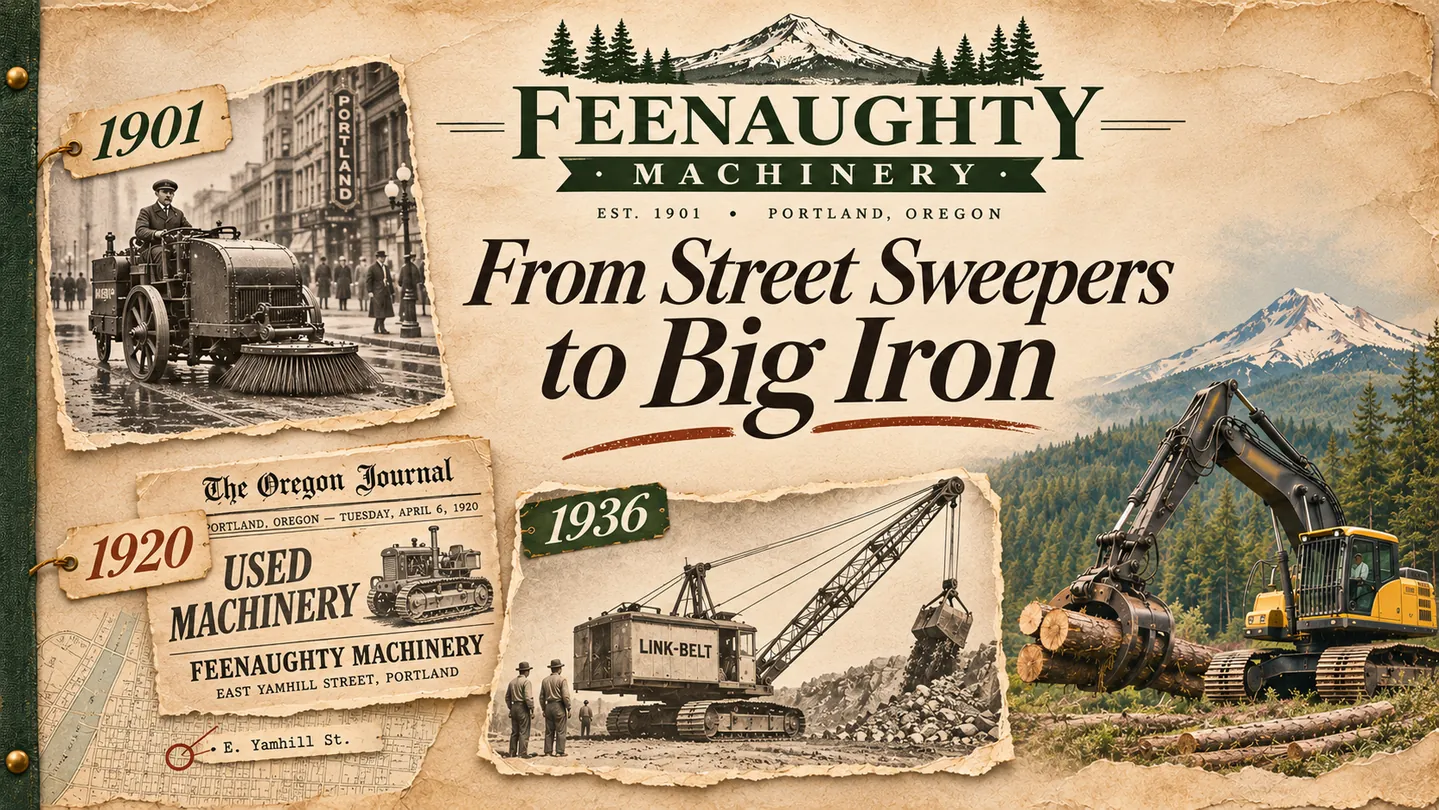
In the summer of 1920, a Portland newspaper offered used machinery at 40 to 60 cents on the dollar. The seller had engines and separators from Case, Rumely and Russell. The address was 309–315 East Yamhill Street, the telephone number was East 509, and the name was Feenaughty Machinery. A century later, that same name would be attached to excavators, log loaders and a family that still believed the telephone mattered.
The bargain ad on East Yamhill
There it is on a crowded newspaper page from July 1920: a small advertisement for used separators and engines. Case, Rumely and Russell appear among the names. The prices are the kind that make you look twice, pitched as 40 to 60 cents on the dollar. A Portland address and an old exchange-style telephone number complete the picture.
You can almost hear the question behind it. What machine can I afford that will get the work done? The brand, location and century are different now, but the problem is familiar to anyone who has ever shopped for used equipment. A promising price only matters if the iron will actually work.
Feenaughty Machinery was already nearly twenty years old when that advertisement ran. The business had begun with an entirely different kind of machine, in a city still growing into its industrial future.
The man who came west for timber and found streets
William Orlando Feenaughty came from New York to Portland hoping to work in timber. Instead, in 1901, he started selling street-cleaning machinery. Before big yellow excavators, compact tracked loaders and forestry attachments, there were streets that needed to be cleaned, crews that needed help, and machines built to make those jobs easier.
The oldest family photograph on Feenaughty's own website shows William Orlando near the center of an early staff group, with his son Donald among the men around him. It is the kind of photograph you could study for an hour: the clothing, the faces, the relationship between a small group and an entire business that would eventually outlive them.
The company didn't stay in street cleaning. It followed work wherever work moved. That's the first useful thing this history teaches: when a business survives through generations of machinery, the common thread isn't the product. It's the problem the product solves.
A machinery store that seemed to sell everything
A 1920 Portland directory lists Feenaughty at East Yamhill with road machinery, Avery tractors and separators, and equipment for moving earth and rock. In its pages the company appears as successor to Hodson-Feenaughty, a name that hints at an earlier chapter of partnerships and business changes.
Notice how wide that offering already was. A separator has very little in common with a street cleaner, and a road scraper is a different animal again. But to the customer, each is simply a way of turning energy into useful work. One farmer needs to process a crop; a road crew needs to move dirt; somebody else needs a machine that can survive long hours.
In that sense the company was becoming a generalist in a world of specialists. It wasn't promising a magical solution for everyone. It was learning what different machines could do for people who had real work waiting.
The rock drills and compressors arrive
By 1935, the company was operating on a regional scale. A trade-publication announcement recorded W. O. Feenaughty Machinery as the exclusive distributor for Gardner-Denver products in Oregon, Washington and Idaho. The equipment list had the vocabulary of hard rock and industrial work: rock drills, air tools, hoists, drill steel, portable compressors, pumps and accessories.
A century-old machinery business can make the past look inevitable. It wasn't. Each new line meant understanding different crews, different maintenance needs and different ways a machine could fail. An air compressor is only useful if the tool it powers works when the job needs it.
This was a long way from a street cleaner, and still exactly the same business in one important respect. Machines were changing the speed and scale of physical work, and Feenaughty wanted to be part of supplying them.
1936: cranes, draglines, and a family name on the masthead
A year later came another remarkable paper trail. In March 1936, Western Construction News announced that Link-Belt had appointed Feenaughty to distribute shovels, cranes and draglines around the Pacific Northwest. The headquarters was Portland, with branches in Seattle, Spokane and Boise.
The announcement named William Orlando as president and D. J. Feenaughty as secretary, with J. I. Overman as vice president and F. A. Kingston managing sales. It was a brief piece of trade news, but imagine the equipment behind those few lines: steel-boomed cranes, digging machines and heavy lifting equipment that helped reshape the region's roads and industrial landscapes.
This is the kind of document a family might not think to frame until somebody finds it ninety years later. It captures the company at a specific moment, with family names and branches spread across several states. It also proves that the jump from a Portland street-cleaning supplier to regional heavy machinery happened surprisingly early.
Five generations is not a straight line
By the time the company reached the era of Kobelco, Takeuchi and what is now Develon, the equipment looked entirely different. The family tree had changed shape too. The Feenaughty name came down through Randy Harris's mother's side; Randy's father had married into the family business.
One of the most revealing passages in a 2023 Equipment World profile is about choices that were not inevitable. Randy Harris had considered a different future before a call from his father brought him into the company. Later, when his own sons Brendan and Grant grew up, he did not insist that they inherit the business. They tried other paths first. His reasoning was practical: a reluctant successor cannot earn a crew's trust just by carrying the family name.
The profile placed the changes in concrete terms. Randy described joining a business of roughly twenty employees and ten million dollars in revenue, then watching it grow to approximately sixty employees and seventy-five million dollars. Those were figures reported in 2023, not current financial estimates. Behind them were decisions about new branches, taking care of skilled mechanics, and growing slowly enough that personal service was still possible. The most impressive number may not be revenue at all. It may be how many people had to believe that answering the phone still mattered as the company became larger.
Randy didn't grow up with a simple plan to inherit the company. He was thinking about moving to Oklahoma City when his father called and encouraged him to come work in Portland. He began in the parts department, learning what made the operation work after the machine was sold. Roughly five years later, his father retired and the responsibility landed on him.
There's a particular kind of education in starting with parts. A sale is a moment. A missing component can become an entire week. A business that knows what customers need once a machine stops has an advantage no marketing campaign can manufacture.
From twenty people to a much larger operation
At the beginning of Randy’s tenure, Feenaughty was about a twenty-person, $10-million business. A 2023 industry profile described roughly sixty employees and revenue approaching $75 million. The family operation had grown alongside the work its customers needed to do.
Growth brought tension. The business had operated stores in Portland and Eugene, as well as Seattle, Yakima, Spokane and Boise at different points in its history. Not every expansion was permanent. Building a new location meant more than hanging a sign: you had to find people who knew the machinery, could run the shop and would protect the customer relationships.
Randy's sons Brendan and Grant brought their own ambitions. He leaned toward caution after decades of learning how expensive mistakes could be. They pushed the business forward. The argument wasn't simply about becoming bigger; it was about what kind of company could remain recognizable as it grew.
The two rules on the wall, whether written there or not
The Feenaughty philosophy could almost fit on the back of a service ticket. Do the right thing. Answer the phone.
The company's famous rules sound almost too ordinary to carry a history: do the right thing and answer the phone. But the same profile explains why they are harder in practice. Calls arrive when a machine is broken, when a promised repair is delayed, or when the customer has a reason to be unhappy. Randy and Brendan described getting into the yard themselves, moving parts and helping wherever the staff needed them. They did not present the rules as a substitute for competence; they treated them as the beginning of accountability.
That attitude also earned recognition outside the business. Feenaughty was named a finalist for Equipment World's 2023 Big Iron Dealer of the Year, and sales representative Billy Parker was recognized by Takeuchi for his 2022 sales work. Awards alone can sound like advertising. In this story they are more meaningful as evidence that the culture described by employees and customers was visible beyond the showroom. Generations of family ownership mattered because people in the shop and the field continued to give the name its reputation.
A contractor calls because the machine is broken. A crew is waiting, the job is slipping, and the customer wants a person who will pick up, even if the answer isn't what anyone hoped to hear. At Feenaughty, the expectation became that the call gets answered and the problem gets passed to someone who can help. The owner might be in the yard. A manager might be washing a machine. A salesperson might be delivering a part.
One forestry salesperson described being willing to drive several hours to reach a customer in a pinch. Another part of the culture was that nobody was too senior to do an unglamorous job. A machine still needs to be washed, a part still needs to travel, and somebody still has to take the call.
Those aren't the details that appear in a manufacturer specification sheet. They're the details people remember when they're choosing who to call again.
The children who were allowed to choose
There is an unusually human twist to the succession story. Randy didn't want his own children ordered into the family company just because their surname qualified them. He wanted them to arrive because they wanted the work.
Grant nearly went into law. Brendan learned business in another industry. Both eventually returned. That choice mattered to a father who had inherited responsibility earlier than expected and had seen what happened when a business grew faster than the people leading it.
There were practical expectations alongside the sentiment. Mechanics needed training as controls and attachments changed. Managers needed to know the people on the shop floor. The family made room for employees' own families, too, recognizing that a technician has children, school events and a life outside a service bay.
A business can be family-owned without feeling like family to the people who work there. Feenaughty's next generation inherited the challenge of doing both.
The next call after the last machine
Back in 1920, somebody could buy a used separator or engine from a small advertisement on East Yamhill. In 1936, Link-Belt was talking about cranes and draglines across the Northwest. By 2023 the family had built a much larger dealership supporting tracked machines, complex attachments and the people who run them.
The machinery kept changing. The work got more demanding. The parts grew more complicated. But the old problem didn't disappear: a person has a job to finish and needs a machine, an answer or a little help.
The next phone call won't look like a historic milestone. That's probably the point. Most legacies are built one ordinary working day at a time.