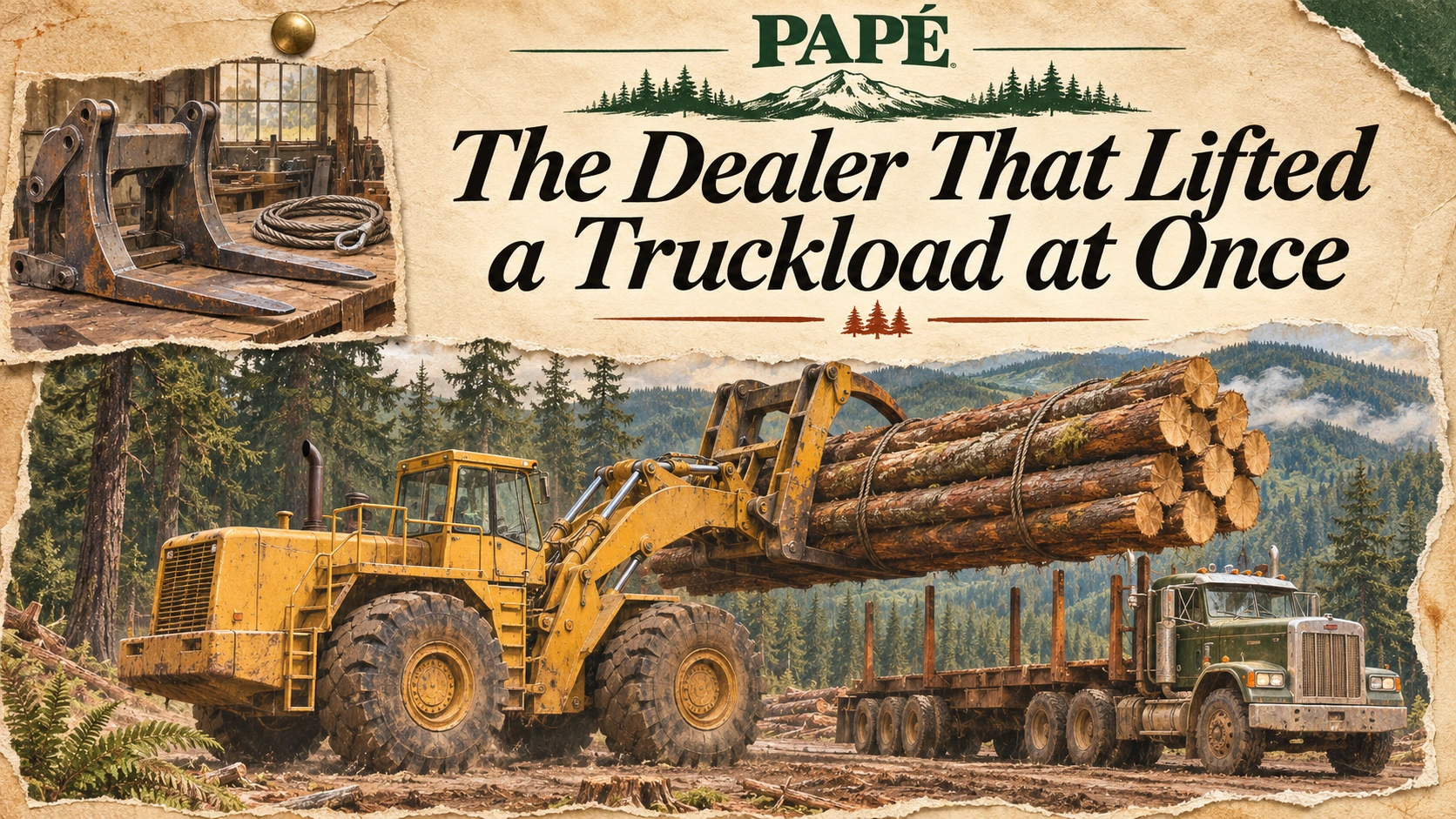
The load weighed 63,000 pounds. Papé's account of its late-1970s Caterpillar 988B conversion describes taking a fully loaded log truck in a single pass.
It is an arresting image: a whole truckload of timber lifted at once. Behind it is a quieter story about a family that kept changing equipment to fit the work.
Before the dealership, a blacksmith
The family history reaches back to Henry Papé, who apprenticed as a blacksmith in Portland and worked at Willamette Iron Works before becoming chief engineer on Northwest river steamers.
His son, E.C. Papé, earned a mechanical-engineering degree in 1913. He worked at Willamette Iron and Steel, progressing from apprentice to draftsman and plant manager.
Long before the first dealership
The history of Papé is usually dated to 1938, when E.C. Papé purchased an equipment dealership in the Willamette Valley. But the family's understanding of heavy machinery began earlier. Henry Papé trained in blacksmithing in Portland, worked for Willamette Iron Works, and later served as chief engineer on river steamers in the Pacific Northwest. His son E.C. studied engineering and worked his way from apprenticeship through drafting into plant management at Willamette Iron and Steel. The work involved manufacturing and the mechanical systems that supported the region's growing industries.
During the First World War, the company supplied work for the Navy, including patrol vessels and minesweepers, according to Papé's published chronology. In the 1920s, E.C. was involved in a merger involving industrial equipment and hoists. Then the Depression arrived and the business arrangements changed again as companies struggled to remain viable. His later move into an equipment dealership did not emerge from a simple, uninterrupted rise. It followed years of engineering experience and a difficult period in manufacturing.
That background makes the decision to buy a tractor dealership more interesting. E.C. was not arriving as someone who merely liked machines. He understood how they were made, how they could be modified and how much work depended on them. He had also seen industries change rapidly, sometimes through invention and sometimes through financial pressure no individual business could control.
The place where the family story becomes memorable is not a ceremonial founding date. It is the combination of trades passed across generations: a blacksmith, an engineer, a manufacturing executive and then a dealer learning what farmers and contractors needed from equipment in the field. The shop and the showroom were never completely separate worlds. Explore Papé's company timeline.
A blacksmith's shop, a steamer's machinery and an equipment dealership seem like separate worlds. In this family history, they belong to the same line of work: understanding how a machine earns its keep, and what to do when the task asks more of it.
Hazel holds the business together
E.C. acquired Slate Tractor in 1938, establishing the business in Oregon's Willamette Valley. His sons, Ed and Dean, later served in Europe during World War II.
E.C. died in January 1945 while they were overseas. Hazel Papé ran the dealership until her sons returned and took over its leadership. She remained involved on the board into her nineties.
The person who kept the doors open
In the family history, the most important transition does not begin with a machine. It begins with a loss. E.C. Papé died on January 14, 1945, while his sons Ed and Dean were serving overseas in the Second World War. Papé's official timeline records Dean's service with Army engineers building bridges along supply routes. Ed served with the infantry, landed in Normandy shortly after D-Day and received the Purple Heart. They were separated from the family business at the very moment it needed someone to carry its responsibilities.
Hazel Papé did that work. The company records that she ran the dealership while her sons remained abroad, and that she stayed involved on the board into her nineties. The record does not preserve every decision she made behind the counter or in the office, and there is no reason to invent them. The essential fact is enough: at a moment when her family had lost its founder and its next generation was away at war, the business continued with her in charge.
It is tempting to tell a family dealership's history as a sequence of men developing ever-bigger equipment. Hazel makes that account incomplete. Without the people who keep the organization functioning through crisis, there is no next model to sell and no later generation to celebrate. The brothers returned in October 1945, according to the company timeline, and leadership passed to them. They inherited not only a business their father had founded, but one their mother had preserved through an extraordinary interruption.
When later chapters celebrate inventions and expansions, it is worth remembering the work that made those future chapters possible. A dealership is not only its manufacturers, buildings or machines. It is also the person who makes sure someone can unlock the doors the next morning. Read the family succession chronology.
The machinery gives this story its scale. Hazel gives it its human center. Before the later branches and specialized equipment, somebody had to keep the original business going through a family loss and a war.
The woods ask for something different
Ed and Dean expanded the business into Roseburg and Coos Bay. The company became a Caterpillar dealer in 1956. In the following decade, the brothers helped introduce rubber-tired skidders to Northwest logging.
Choosing a direction when the industry changes
After the war, Ed and Dean Papé were operating in a region whose equipment needs were changing. They expanded into Roseburg and Coos Bay, close to timber country as well as agricultural customers. Then came a decision that sounds technical but could reshape an entire dealership. In 1953, Allis-Chalmers required dealers to choose between agricultural and industrial product lines, according to the company's history. The brothers chose industrial equipment. They were betting that the machinery needed for logging, construction and heavy work would define the next stage of their business.
The decision was followed by commercial success and another major change. Papé's chronology records an Allis-Chalmers recognition in 1955 for record new-tractor sales in the Northwest, then the purchase of a Caterpillar dealership in 1956. The manufacturing relationship changed, but the practical work continued: finding equipment for customers whose jobs involved moving timber, earth and heavy loads.
The following years were hardly an easy, predictable march toward growth. In 1970 the company expanded east by acquiring Crater Lake Machinery, reaching Redmond, Medford and Klamath Falls. A few years later, inflation and the 1973–74 oil embargo created painful conditions for equipment-dependent businesses. Machines still had to run, but fuel and financing could suddenly change the arithmetic. Customers and dealers alike were operating in an economy that did not cooperate with their plans.
By 1981 Randy Papé, Dean's son, became president, beginning another generation of leadership amid the early-1980s downturn. The company's later diversification makes more sense against that backdrop. A business that tied its future to one machine type or one cyclical industry could be vulnerable when its customers were hit by changing demand. The Papé story is not simply one of more branches. It is a record of choices made when the equipment business refused to stand still.
Papé's 85th-anniversary account places that skidder chapter between 1965 and 1969. It also records a 1978 modification of the Caterpillar 245 excavator for logging.
These are useful details because they show a dealer participating in how the work was done. The customer brought a job in the woods. Equipment had to make sense there, among the trees, terrain and material that defined the day.
A specification sheet begins the conversation. The actual job finishes it.
An entire load in one pass
The wheel-loader conversion makes that idea visible. Papé took the Caterpillar 988B, a machine ordinarily associated with a bucket, and adapted it for log handling. Its 2018 history gives the striking 63,000-pound figure; its company timeline describes the result as a single-pass Cat wheel log loader.
What a single lift changed
Equipment histories can make innovation sound effortless by stating the result without describing the question. Logging crews had to move awkward, heavy material across uneven terrain and into a transportation system that waited at the edge of the woods. The time spent positioning, lifting and moving timber mattered. Equipment that reduced handling could change how a crew planned a job, even before anyone calculated the savings on a ledger.
Papé's published timeline identifies three related experiments in the 1970s. The business adapted an excavator for log loading, converted a Caterpillar 988B wheel loader into a machine able to lift a complete load of logs in one pass, and modified a Caterpillar 245 excavator in 1978 for moving whole trees in a method associated with shovel logging in the Cascades. The machines had different jobs and the historical record should not collapse them into a single invention. What they share is the use of an existing machine as the starting point rather than the final answer.
The celebrated 63,000-pound lift is one striking measure. Its meaning is easier to see when considered from the crew's side of the job. A log truck has to be loaded, moved and unloaded; machines and operators have to be in the right place; awkward handling consumes time and creates more opportunities for delays. The goal was not to produce the largest number for a brochure. It was to alter a repeated physical task so it could be done differently.
It is important not to promise that one machine eliminates every difficulty. Terrain, log size, machine condition and operators always matter. The historical accomplishment is narrower and stronger: a dealership was willing to change a proven machine because customers faced a specific material-handling problem. That is the kind of knowledge that does not always appear in a standard specification table. See the equipment timeline.
The story invites a different way of looking at equipment. A machine's value lies partly in the steps it can remove from a job. One lift instead of repeated handling is a change in the rhythm of the work.
That does not require a grand theory of innovation. It requires paying attention to a task people already do, over and over, then asking whether the machine can do it differently.
Eighty years later, still talking about logs
Between the early logging inventions and that conference display, the company had changed shape in another way. In 1990, Randy Papé added Hyster dealerships in Oregon, Washington and California and formed The Papé Group. The business expanded into material handling, trucking and other kinds of working equipment alongside agriculture and forestry. Each new category brought different customers and another reason to make the dealer's knowledge useful after a machine left the lot.
That is the ripple effect of an equipment company that listens beyond the first sale. A loader might help a logging crew. A lift truck might help a warehouse. A truck might carry the load between them. The machines were different, and they would never share a single answer to every job, but a family business that began with a tractor had learned to follow the work wherever it moved.
In its announcement for the 2018 Oregon Logging Conference, Papé traced its involvement in the event back to 1938, the same year its dealership began.
From one shop to several kinds of working life
By the 1990s, the Papé name was associated with more than machinery for the woods. Randy Papé expanded into Hyster material-handling dealerships in Oregon, Washington and California and formed The Papé Group. In the company's telling, this was not a decision to forget its early customers. It was a recognition that agriculture, construction, trucking and warehouse work all had equipment needs that could change with the economy.
A forklift in a warehouse, a truck on a highway and a loader at a landing may have little in common visually. For the people operating them, however, the recurring concerns sound familiar: getting the right machine, keeping it maintained, finding parts and limiting the hours when work has to stop. A dealer that understood those questions in timber country could bring useful habits into other sectors, provided it also learned the specialized demands of each new trade.
That widening reach had a human consequence as well as a commercial one. More locations and equipment lines meant more places where mechanics, counter staff, drivers and salespeople could make careers. Papé's 85th-anniversary account points to the family's support for education, youth organizations, medical charities and community groups. Such commitments cannot be measured solely in units shipped or horsepower sold. They are part of how a long-lived business participates in the communities that make its operations possible.
None of that requires treating every expansion as a triumph. The interesting story is that a family equipment company kept confronting unfamiliar decisions, inherited responsibility during hardship, and found different ways to make itself useful to the people around it. That is why the engineering discoveries and the community record belong in the same account. Read the company's anniversary history.
The planned display had grown to more than thirty pieces of equipment. There would be a connected-machine specialist, a virtual-reality booth and a truck inspection and loading demonstration. Visitors could also watch the log-loader competition.
That small event notice captures the distance traveled. The business that began with farm and industrial iron was now bringing machinery, data and virtual reality to the same industry gathering. People still wanted to see what a machine could do, and talk to someone who understood the work.
Buy for the job that is waiting
Papé's history is full of equipment changing shape around a customer's task. For a buyer today, that is a useful starting point. Describe the load, the terrain, the space and the hours before getting attached to a model number.
There is also a side of the legacy that a photograph of a 63,000-pound lift cannot show. In its 85th-anniversary account, Papé described supporting FFA organizations, local education foundations, family centers, children's hospitals and United Way of Lane County. The company did not attach a grand total to that list. It named the places where its community commitments took shape.
That detail belongs beside the machine inventions. Hazel keeping the business alive through wartime loss, Ed and Dean changing how timber was handled, and later generations investing in the communities around their yards are different kinds of work. They share a habit of treating the next person's problem as something that deserves attention. It is a more enduring legacy than the weight of any single load.
Ask what attachment makes the machine useful, how it will be serviced, and which part of the job it is supposed to improve. Those answers give the purchase a purpose you can actually test.
The wheel loader is the memorable part of this story. The more durable idea is the question behind it: what would it take to make the work go better?
The achievement behind the number
A reader could leave the Papé story remembering only the 63,000-pound log lift. It deserves to be remembered; it is an extraordinary image. But imagine instead arranging the company's history by the people who made the next chapter possible. Henry's mechanical skill, E.C.'s engineering career, Hazel's stewardship during wartime, Ed and Dean's equipment decisions, and the generations who broadened the work into other industries. In that version, a lift is one moment in a much longer sequence of human effort.
The best tribute to an equipment business is not to claim that every choice was brilliant. It is to show exactly where people took responsibility, found another way to do a difficult job, and helped someone else keep working. That gives the famous loader its proper place. The machine could lift a truckload. The family business had to carry its responsibilities across decades.