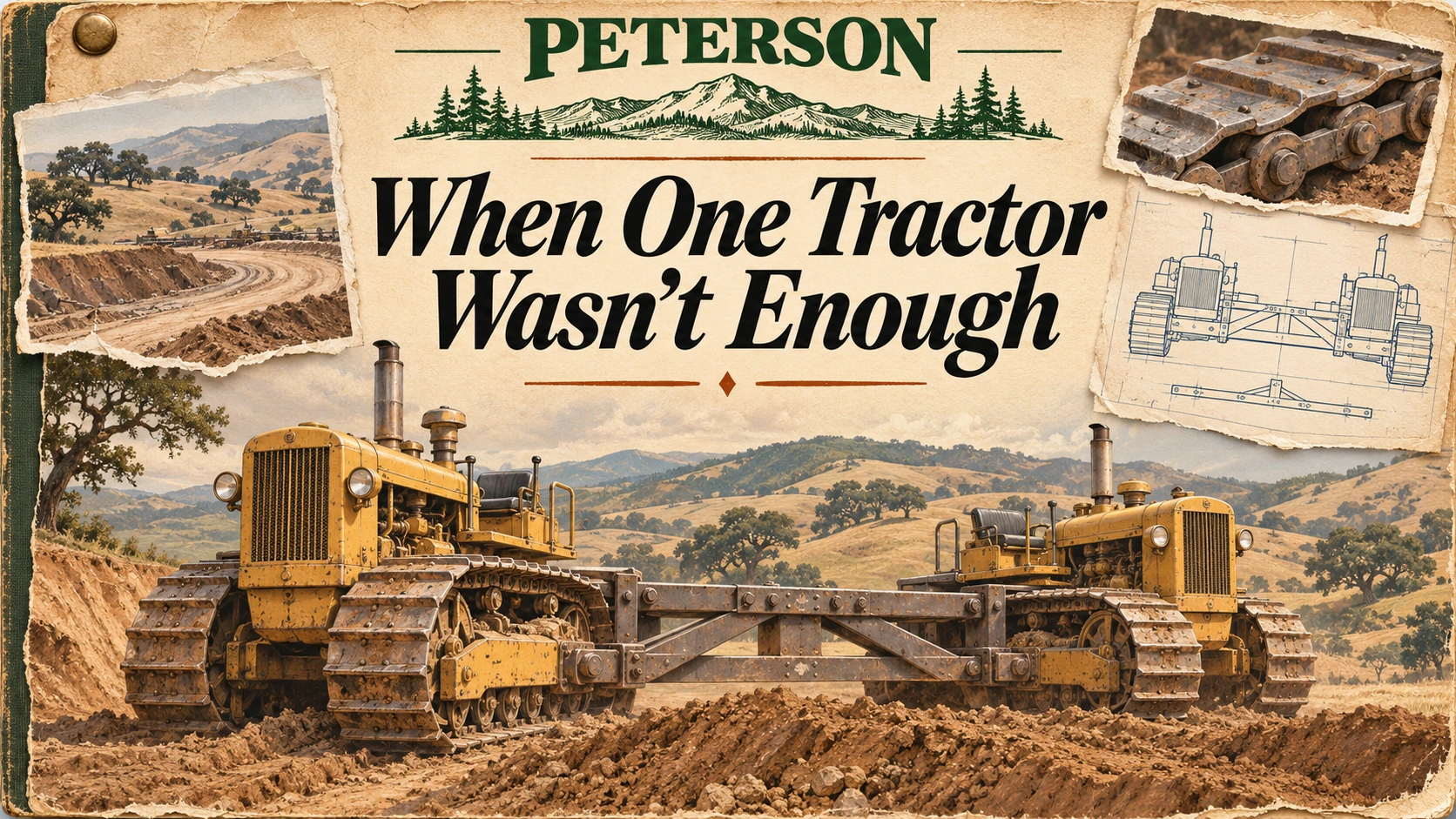
A bulldozer is already an argument with the landscape. Peterson's answer was to put two of them together.
The Twin D8 looked improbable: two Caterpillar tractors joined side by side, their inner tracks removed, their power gathered behind one enormous blade. One operator controlled the resulting machine. And buried in the patent is a detail almost as interesting as the extra muscle: this giant was designed to come apart for the trip to work.
The workshop behind the sales counter
Howard Peterson founded Peterson Tractor & Equipment Company in the San Francisco Bay Area in 1936. His brother Buster joined the business in 1943 and began developing customized tractor equipment. The company moved its headquarters to San Leandro in 1948.
The sequence matters. A dealership was becoming a place where the machinery itself could change. Selling the available machine was one kind of work. Figuring out what to do when that machine did not quite fit the assignment was another.
A shop willing to change the specification
There was an important distance between the two places where this machine took shape. Peterson Tractor in California developed the idea and the conversion components. The contractor's machinery, however, had to work in Montana. For the Hungry Horse job, the assembly took place in Kalispell at Westmont Tractor & Equipment, and the giant blade came from another shop altogether. The finished tractor was not delivered from a factory as a standard product that could be ordered by model number. It depended on different people solving different pieces of a single problem.
A 1950 news account quoted in Peterson's company history describes mechanics Gerald McDonald and Frank Janicke finishing the coupled machine in the Westmont shop. There is the most human detail in an otherwise spectacular engineering story: mechanics doing the careful work that turns a drawing into something a contractor can start, steer and trust in the field. The name on the dealership did not weld the machine together. People with specialized skills did.
The distinction is worth remembering because it changes what we mean by a dealer's contribution. Peterson did not merely sell two Caterpillar D8 tractors. It put an idea into circulation, supplied drawings and parts, and helped make it possible for a customer far from San Leandro to adapt proven machines to a new task. In a business measured in horsepower, the truly scarce thing was a workable answer to a problem that ordinary equipment could not quite solve. Read the company's account of the assembly.
Peterson's history places the Twin D8 among those answers. The image is unforgettable because the solution is so physical. Two familiar tractors have become a single unfamiliar one.
One operator, two power plants
The original document is U.S. Patent 2,678,105, titled Tractor with Twin Power Plants. It names Robert A. Peterson of San Leandro as inventor. The application was filed January 18, 1951; the patent was granted May 11, 1954.
Its technical argument goes beyond doubling the engines. Each power plant drives its own side of the vehicle. By varying their speeds, the operator can turn while both sides remain powered. The patent describes this as a way to avoid the power loss and roughness associated with steering by braking or slipping a clutch on one side.
A patent for what happens between two engines
Two engines do not automatically make one useful tractor. Put two machines next to each other and an operator still has to steer, manage traction, and keep each power plant doing its part. Peterson's 1954 patent is unusually revealing because it describes those problems rather than merely celebrating the machine's size. Each side retained its own source of power. The idea was to coordinate them without treating one as dead weight when the machine needed to turn.
That mattered on the ground. A heavy tractor cannot afford to waste its power simply fighting the other half of itself. The patent discusses changing the relative speeds of the two drives to steer while keeping both tracks working. It also addresses how the combined machine could be separated for transport. The people who designed it were thinking beyond the dramatic photograph of two hoods behind one blade. They were considering the miles between jobs, the available carriers, the mechanics who would reassemble it, and the operator expected to handle it afterward.
The paper record makes the ambition feel more practical, not less. The innovation was not a magic trick: it made several difficult tasks possible in a specific sequence. Build it, move it, put it to work, service it, and then move it again. A reader looking only at the blade might see a stunt. Read the engineering description and a more interesting picture emerges, of a dealership trying to solve the entire working life of a machine. Examine the original patent drawings.
Then comes the travel problem. A machine can be tremendously capable at a jobsite and tremendously awkward everywhere else. Peterson's design addresses that directly: divide it into halves, transport those halves on conventional highway or rail carriers, and put the machine together again at the destination.
The invention had to fit the road to the job as well as the job itself.
The giant assembled in Montana
Peterson's illustrated company history follows a Twin D8 to the Hungry Horse reservoir project in Montana in 1950. Conversion parts and drawings traveled to Westmont Tractor & Equipment in Kalispell, where two new D8s were combined for contractor J. H. Trisdale.
This was a network of people and shops doing different pieces of the work. Peterson supplied the design. Westmont assembled the tractors. Trisdale's California shop built a blade measuring 21 feet 8 inches across and shipped it north.
The machine brought roughly 270 horsepower to reservoir clearing. Its unusual outline is worth lingering over: two hoods behind a working edge wide enough to make a conventional dozer look modest.
The contractor did not need a strange-looking tractor for its own sake. The Hungry Horse Reservoir area had to be cleared before the dam could do its work. In Peterson's published history, the Twin appears among a much larger operation of cutting, pulling and removing timber and roots. The contractor's rake stretched more than twenty-one feet across and carried thirteen teeth. That was the practical purpose of putting two D8s together: cover more ground in one pass and keep the clearing moving.
By September 1952, the two contractors on the clearing operation had cleared 14,695 acres in all, according to Peterson's history. That is the total for the operation, not a claim that one Twin D8 cleared the entire acreage. It gives the machine something more meaningful than a dramatic photograph: scale. The unusual tractor had been designed for the kind of immense, stubborn job where moving one more root or making one more pass mattered.
Before the dam could fill, the ground had to be cleared
The reservoir project supplies a setting big enough to explain the Twin. The forested ground destined to lie under water could not simply be left as it was. Peterson's published history recounts the clearing operations, including the removal of roughly eighty million board feet of timber before contractors turned to brush, snags and roots. The operation was not the work of one tractor. It involved logging crews, haulers, multiple contractors, machines of different sizes and a succession of solutions to the same stubborn terrain.
One of those solutions was almost as startling as the Twin itself. Before the coupled tractor was used, the contractors dragged huge hollow steel balls across the clearing. Five balls, each about eight feet in diameter and weighing approximately four and a half tons, were made for the operation. Cables pulled the balls between tractors to knock down smaller remaining growth. Their design kept the cable above the ground to reduce the chance of catching on stumps. The engineering was rough-looking but carefully considered.
The Twin D8 then had a different assignment: the roots and heavier debris left behind. Its immense rake could gather material that other machines had exposed. A project described in acreage can feel abstract until you see why an individual root mattered. It was one obstacle in a much wider sequence of getting ground ready for a reservoir. A strong engine was important, but so was knowing when to use it and when another method worked better.
Those 14,695 acres recorded by September 1952 were the result of both clearing contractors' work, not the achievement of Peterson's machine alone. Keeping that distinction intact makes the story more impressive, not less. The Twin belonged to a system of human ingenuity rather than a fairy tale about one extraordinary machine accomplishing everything. See the Hungry Horse clearing account.
The tractor is the spectacle, but the story is the collaboration required to make such an unusual machine useful.
The idea outgrew the D8
The joined-tractor idea kept evolving. Peterson developed the Quad D9, and Caterpillar's own history identifies that dealer-built concept as the ancestor of its Side by Side D9G.
Caterpillar's version paired two D9Gs behind a 24-foot blade. A single operator ran the coupled machines from the left tractor. The manufacturer describes applications ranging from coal stripping and reclamation to stockpiles and site preparation.
Here was a dealer invention feeding into a manufacturer's product history. The workshop had become more than a place to maintain machines. It had become a place where the next machine could begin.
A second Twin goes to Texas
The Montana machine was not the only test of the idea. A later account in Equipment World, drawing on Peterson's historical book, describes a high-clearance Twin built for the King Ranch in Texas and delivered through the Caterpillar dealer in San Antonio in March 1951. This was not reservoir-clearing equipment in a different paint scheme. The terrain and task demanded another set of decisions. The machine reportedly weighed about fifty-two tons, offered thirty-six inches of ground clearance, and carried a front knockdown bar as well as a specialized root plow at the rear.
The knockdown bar was meant to topple mesquite growth; the plow cut beneath the surface to limit regrowth. The machine even carried a seed blower behind it, so the cleared ground could be reseeded. Notice how different that assignment is from the Hungry Horse project. One job needed to prepare forested ground for water. The other involved clearing and restoring ranchland. The useful machine was not defined by the novelty of two coupled tractors. It was defined by what each customer needed the machine to accomplish when it arrived.
The reported purchase price, roughly $55,000 in 1951, is a historical figure, not a present-day equipment comparison. The larger lesson is that the conversion had to justify itself on a difficult job. Adding a second engine increased capability but also created enormous costs, complexity and transport questions. A custom machine made sense only where the work called for something ordinary machines could not efficiently provide.
This second example gives Buster Peterson's engineering a wider significance. He was not merely repeating a successful invention. He was adapting the principle to a different landscape. Explore the King Ranch machine.
Nor was the Twin the end of Buster Peterson's experiments. In 1965, Peterson built a Triple 657 scraper for work associated with the San Luis Canal project. The company's later historical account says the custom machine cost close to a million dollars at the time. Don Peterson, Buster's son, remembered its value in a different way: it showed major contractors the kind of difficult equipment problem the dealership was willing to solve.
That may be the more lasting measurement of this kind of invention. Not every contractor needed a coupled bulldozer or an enormous scraper. The ones with unusual jobs needed to know who could listen carefully, draw an answer, fabricate it and stand behind the result. A dealer's reputation traveled farther than any single machine. The Twin D8 was made from existing iron, but the real achievement was teaching the industry to expect more from the people who sold it.
A different question to bring to the yard
Peterson's Twin is a good reminder of what an equipment conversation can contain. Horsepower is part of it. So are transport, steering, attachments, the ground under the tracks and the person who will operate the machine.
For a buyer today, the useful question is wonderfully ordinary: how will this machine actually do my work? Ask how it gets there, who supports it and what happens when the job changes.
Most answers will involve something less dramatic than joining two bulldozers. But the instinct behind the Twin still belongs in the conversation: understand the job deeply enough to see a better way to do it.
Why the most memorable machine was not permanent
There is a revealing limit to the Twin's success. In the middle of the 1950s, Caterpillar introduced its more powerful D9, and machines that had once required two coupled tractors could increasingly be handled with a purpose-built model. The Twin D8's usefulness did not last indefinitely. That is not evidence that the experiment had failed. It is part of what makes the episode important. A dealership recognized a gap, built an answer, and helped demonstrate the demand for greater capability before a standardized machine could fill it.
The photographs are arresting because the Twin looks unlike anything else. But the design's eventual obsolescence is almost as revealing as its appearance. The job did not care whether the solution was picturesque. Contractors needed acreage cleared, earth moved and machines that made economic sense. Once better equipment became available, ingenuity could take another form.
Buster Peterson's later Quad D9 and other conversions show that the company continued asking the same question rather than guarding a single invention. What could be changed so the work could move? The dealer's achievement was not keeping the Twin alive forever. It was proving that the people between the equipment manufacturer and the customer could help shape the next machine. That is a legacy bigger than a blade.